
To improve map awareness in VALORANT, check information when you're safe, work out what it actually proves, then give your team a short call and change your position or plan. Looking at the minimap more often isn't enough—and staring at it while holding an angle can get you killed.
Last verified: September 8, 2026. Reviewed against Patch 13.05. The examples below are practice recommendations, not guaranteed reads of an opponent's next move.
Use information to make one useful decision
Try this cycle whenever contact changes the round. You don't need to narrate all four steps aloud.
- Check: find the Spike, the latest enemy contact, and the route your teammates aren't covering.
- Interpret: separate what somebody saw from what you suspect. Two enemies seen at A doesn't locate the other three.
- Communicate: say the number, place, and relevant action: “Two A Main; one used a flash. Spike not seen.”
- Act: choose a job—delay, reinforce, hold the uncovered route, help a teammate, or regroup. Recheck when new contact contradicts the plan.
The most useful question is often “What became unguarded?” If your teammate leaves a lane to rotate, their old position stops being evidence that the lane is safe. A camera, trap, or player must still cover the route if your plan depends on it.
Look between threats, not through them
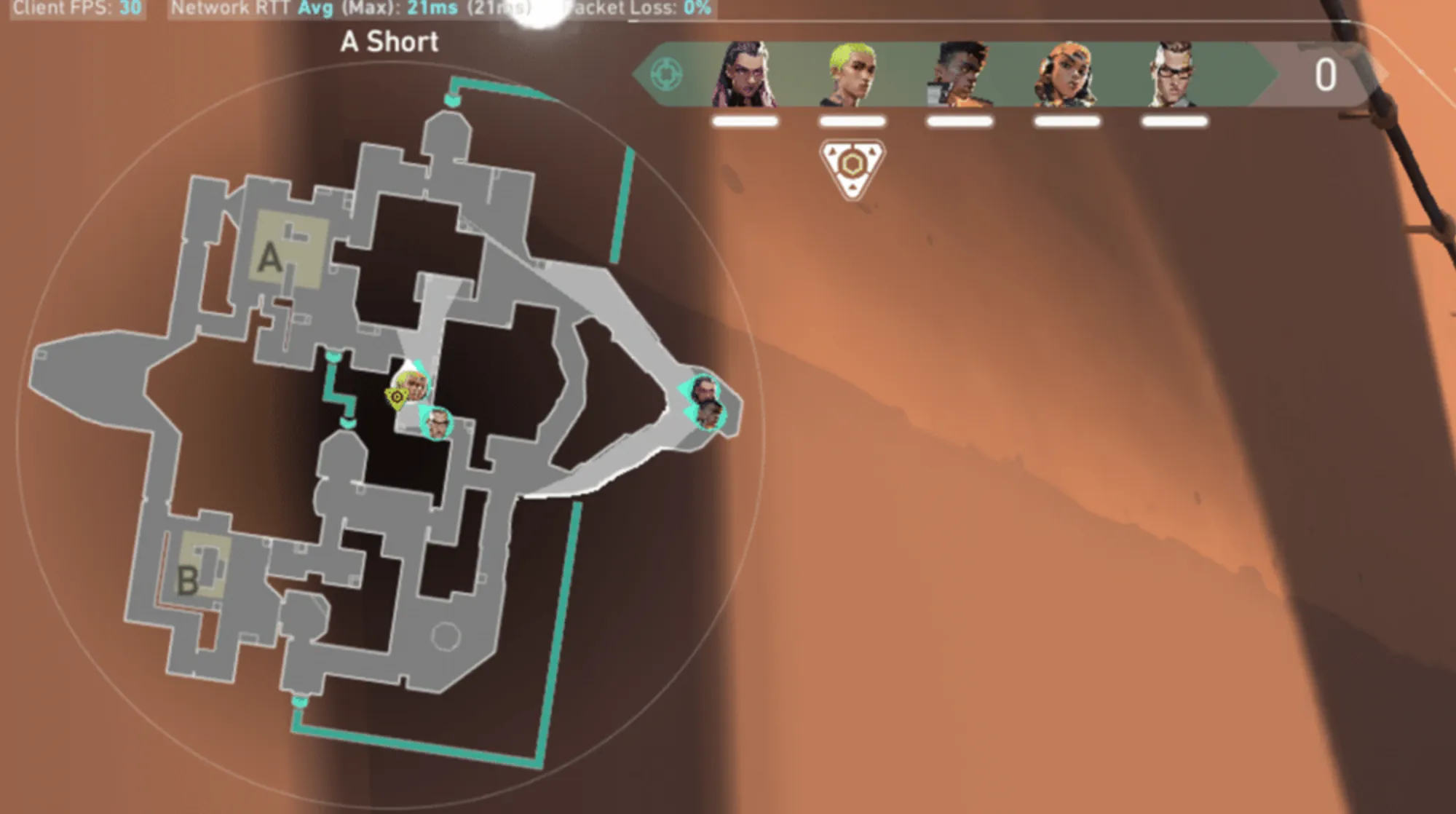
Glance during the buy phase, behind solid cover, after you've disengaged, or while a teammate safely holds the immediate threat. Recheck after a kill, a Spike sighting, a teammate's rotation, or an information ability. These are prompts, not a timer you must obey.
Keep your attention on the fight when you're clearing a corner, exposing yourself to a peek, or expecting immediate contact. Ask for a short voice call if you can't look away. A teammate saying “three crossing” can be more useful than making you inspect icons during a duel.
Make the map readable first. Our minimap settings guide covers size, zoom, and orientation. This guide focuses on decisions after you've read it; changing a setting won't tell you whether a rotation is justified.
Separate a sighting from a guess
| What happened | What it does not prove | Useful response |
|---|---|---|
| A teammate saw the Spike carrier | That the carrier will stay there or that the whole team is nearby | Share the location and how recently it was seen; strengthen the likely destination without abandoning every other route. |
| An entry becomes quiet | That everybody rotated | Expect a pause, walking player, lurk, or fake until another cue supports the rotation. |
| A Recon Bolt scans nobody | That covered corners are empty | Check what the dart could actually see before advancing. |
| Flank utility is destroyed | The attacker's exact position, number, or next direction | Call the lost coverage and assign someone to watch it; don't treat a broken alarm as continued protection. |
| Three different enemies were identified elsewhere | That your own lane is empty | Account for the remaining players and update the count after deaths or fresh contact. |
Treat sound as another clue
Footsteps, gunfire, and ability sounds can tell you where to focus. They don't give continuous vision. A player can stop running or wait outside your hearing range. Call “footsteps B” when that's all you heard, rather than upgrading it to “everyone B.”
Listen before layering more communication over a teammate's clutch. Report a useful new fact once, then let them hear the round. Pings are a workable alternative to voice, especially when you need to mark an unfamiliar location.
Know the limits of your scouting tool
Sova's Recon Bolt reveals enemies in its line of sight and can be destroyed. No scan isn't an all-clear. Likewise, Cypher's Trapwire only covers the route where it is placed; an intact wire doesn't certify an entire side of the map.
Use a drone or other clearing ability to reduce the angles your entry must check, then follow while the information is useful. Don't assume a stun, smoke, or damage ability reported a hit merely because you sent it into a corner. Continue clearing unchecked angles instead of sprinting past them.
Turn the read into an attack or defense plan
Defense: reinforce without giving away the map
On Haven, suppose a teammate reports two attackers at C Long but hasn't seen the Spike. As a nearby defender, you can prepare to help C while checking whether Garage remains covered. The distant A defender doesn't automatically need to run across the map. If the Spike is then seen entering C and more attackers commit, the case for a larger rotation becomes stronger.
The point isn't that one fixed rotation is always correct. Ask what the first defender can delay, which route you expose by leaving, and whether your help will arrive in time. Our Haven Agent guide explains which utility supports that three-site defense.
Attack: a teammate's contact should change your timing
On Ascent, your group pressures A while a teammate takes space toward Market. If defenders respond at Mid, decide together whether to continue A or reconnect for B. Don't count the split as successful just because the minimap shows your teammate far forward: they still need a route into the site and somebody ready to act on their contact.
Track the Spike through that decision. A team can win several duels and still leave its carrier isolated behind the rotation. After planting, choose positions that can help defend the actual plant location instead of chasing the last opponent without a plan.
Practice the decisions you keep missing
- One-route drill: in a custom game, walk from an entry to a fallback position. Name what you can see and what remains unchecked. This teaches coverage, not a memorized “safe” path.
- Coverage drill: during ordinary matches, notice when a teammate leaves their position. Decide whether you must replace that coverage or deliberately give it up.
- Decision review: pick a few rotations after a match. Record the cue, what you believed, the action you took, and whether you ignored available information. Judge the reasoning separately from the result.
Riot's Replay guide documents player perspectives and timeline controls, but also a crucial limitation: the replay minimap can display enemies the player couldn't see live. Turn off enemy outlines when reviewing your perspective, and don't treat the replay map as proof that you should have known an opponent was there. Your own recording can help reconstruct the information actually available.
For a broader review of decisions such as saving, taking space, and choosing fights, continue with improving game sense. Keep this session focused on one recurring information mistake so you can recognize it next time.
Common questions
Should I check the minimap every few seconds?
Not on a rigid timer. Build frequent checks around cover and changes in the round. Your immediate angle takes priority when an enemy can peek you.
Does a quiet site mean the attackers left?
No. Silence leaves several explanations open. Combine it with fresh sightings, Spike information, teammate pressure, and the routes you still control.
How can I improve awareness without team voice chat?
Use short pings, watch teammate positions and coverage changes, and state uncertainty in text when there is time. Don't compensate for missing calls by taking unsafe minimap glances or assuming every unseen opponent is rotating.
Sources and update notes
September 8, 2026: rebuilt the guide around information quality, attention safety, practical decisions, and replay limitations; replaced unrelated and repeated links. Current patch context: Riot's Patch 13.05 notes.


-a6d5b3e156bb.webp)