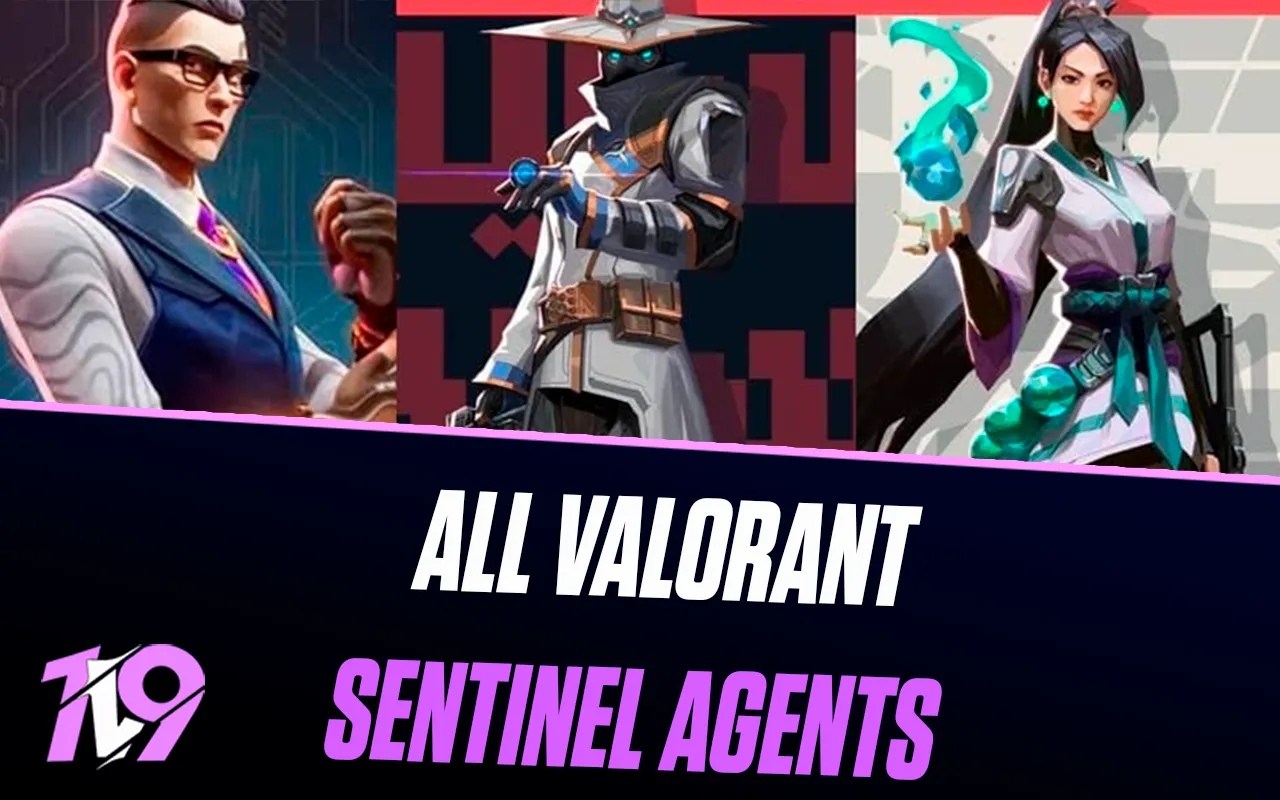


All Sentinel Agents in VALORANT
VALORANT has seven playable Sentinels in Patch 13.05: Chamber, Cypher, Deadlock, Killjoy, Sage, Vyse, and Veto. They all defend space, but they do it through different tools—information, traps, barriers, utility denial, healing, or a weapon-first hold.
Last verified: (VALORANT Patch 13.05)
Every current VALORANT Sentinel
| Sentinel | Defensive identity | Best fit | Main limitation |
|---|---|---|---|
| Chamber | Weapon-led picks, long-range threat, and a retreat anchor | Players who convert precise first contact into an escape | Less passive flank coverage and stall than a trap-heavy Sentinel |
| Cypher | Persistent surveillance and punishable path control | Reading rotations and protecting multiple approach timings | Recognizable setups can be cleared or avoided |
| Deadlock | Movement punishment, forced commitments, and retake catch tools | Choke points where sound and constrained paths create value | Less automatic flank certainty than a traditional tripwire network |
| Killjoy | Range-limited automated information, damage, and site denial | Compact sites and planned post-plant or retake setups | Leaving the activation area can deactivate key utility |
| Sage | Barrier control, slows, healing, and a round-changing revive | Teams that need direct stall and recovery rather than passive surveillance | No autonomous flank alarm |
| Vyse | Triggered isolation, hidden flashes, damaging zones, and weapon denial | Separating an entry from the players who should trade it | Maximum value depends on prediction and setup timing |
| Veto | Utility interception, debuff immunity, a throwable trap, and a local teleport | Holding against utility-heavy, coordinated hits | Gunplay remains essential once enemies destroy or route around the setup |
The table is a role comparison, not a permanent tier list. Map geometry, side, team composition, comfort, and the current balance patch change which Sentinel is the most practical pick.
What does a Sentinel do in VALORANT?
Sentinels make reckless movement expensive. On Defense, they anchor a site, expose or delay an entry, and preserve information about routes nobody is actively watching. On Attack, they protect the team's back, hold gained space, support the plant, and make a retake cross dangerous.
Riot's Patch 13.00 notes described the class as a check on repeated low-information five-player hits. That does not mean every Sentinel must sit behind utility. The role's best rounds combine setup information with a timely gunfight, rotation, or utility re-use.
For the class boundaries, read our guide to every VALORANT role. Controllers block sightlines; Sentinels punish or monitor the space left behind those sightlines.
How to choose the right Sentinel
- Need dependable route information? Start with Cypher or Killjoy, then account for Killjoy's activation range.
- Need a physical delay? Sage's Barrier Orb and Slow Orbs force a visible decision.
- Need to split a committed hit? Vyse isolates and punishes the gap between entry and trade.
- Need to fight utility with utility? Veto can intercept eligible projectiles and protect his own fight from debuffs during Evolution.
- Need sound-triggered punishment in tight routes? Deadlock can turn noisy, constrained movement into a trap.
- Need an aggressive first pick? Chamber trades passive control for a personal weapon and repositioning threat.
Do not pick only from a global win-rate number. Filter any statistic by patch, rank, region, queue, and map, then ask whether you can execute the setup. Our Agent-by-map guide treats those choices as map-specific rather than universal.
Chamber
Chamber is the Sentinel for a player who wants the setup to create a favorable duel. Trademark watches a route and slows caught enemies, Headhunter supplies a precision sidearm, Rendezvous provides a prepared teleport escape, and Tour De Force creates a powerful custom sniper.
Place Rendezvous around cover, not in the open, and decide the escape before taking first contact. Chamber loses value when the player holds an ordinary angle without using the teleport to survive. On Attack, protect the flank without placing Trademark so far from the team that its warning cannot be acted on.
Cypher
Cypher builds a surveillance network. Trapwire punishes a crossed path, Cyber Cage blocks vision and creates an audio cue, Spycam checks space remotely, and Neural Theft reveals living enemies after Cypher uses it on a valid corpse.
Patch 13.00 shortened Trapwire's windup, while the larger 11.08 pass gave nearby enemies clearer Spycam counterplay and reshaped the wire's punish. Rotate placements so attackers cannot prefire the same camera or clear the same wire every round. Information is useful only if you communicate it before the team acts.
Deadlock
Deadlock excels when opponents commit loudly through limited space. GravNet restricts caught movement, Sonic Sensor reacts to sound, Barrier Mesh blocks movement while allowing shots through its open sections, and Annihilation captures an enemy caught by its nanowire path.
A Sonic Sensor is not a conventional always-on visual trip. Place it where enemies must make noise to fight, plant, drop, or rush. Patch 13.00 reduced GravNet's signature cooldown, which makes an early, purposeful use less punishing when the round runs long.
Killjoy
Killjoy controls a compact area with Alarmbot, Nanoswarm, and Turret, then uses Lockdown to force enemies out or risk detention. The automated pieces give information and create a timing for Killjoy to swing; they are not a replacement for the swing.
Patch 13.00 increased Turret fire rate, Nanoswarm duration, and Alarmbot movement speed. Her defining constraint still matters: range-limited utility can deactivate when she rotates too far. Build a setup that covers the most important question, not every possible entrance badly.
Sage
Sage uses Slow Orb and Barrier Orb to change how enemies can cross a choke, Healing Orb to restore a teammate or herself, and Resurrection to return a fallen ally. She is a Sentinel without an automatic flank alarm, so somebody still needs to watch or periodically clear that space.
Patch 13.00 increased Sage's self-heal-over-time total. That improves recovery but does not justify taking unnecessary damage. A strong wall buys time, creates an elevated angle, protects an objective, or forces obvious damage; a default wall broken before contact often gives away credits for little value.
Vyse
Vyse separates and disarms a push. Shear raises a wall after an enemy crosses its trigger, Arc Rose is a hidden reusable flash, Razorvine punishes movement through an area, and Steel Garden temporarily jams affected enemies' primary weapons.
The ideal setup does not simply trigger—it creates an isolated target your team can punish. Hold the crossfire that follows Shear and avoid stacking every tool where one piece of clearing utility can reveal the plan.
Veto
Veto, released in Patch 11.07b, is the newest Sentinel. Chokehold creates a destructible trap that holds, Deafens, and Decays a caught enemy. Crosscut sets a local vortex Veto can reactivate to teleport while in range. Interceptor destroys eligible utility that would bounce off a player or be naturally destroyed by gunfire. Evolution grants a combat stim, regeneration, and immunity to debuffs during the mutation.
Patch 13.00 shortened Interceptor's reclaim cooldown and expanded and accelerated Crosscut deployment. Veto is strongest when the enemy's planned execute relies on utility he can actually intercept. He does not erase bullets or every ability, and attackers can destroy or route around his setup.
How to play Sentinel on Attack and Defense
On Defense
- Change one part of the setup each round so the opponent must gather information again.
- Decide whether utility is an alarm, a stall, or a kill trigger; one device cannot always do all three.
- Call what your utility no longer covers after it is destroyed, recalled, or deactivated.
- Do not die on a site solely to “justify” the setup. Surviving can keep utility active and strengthen the retake.
On Attack
- Cover the route the team cannot afford to re-clear, then stay close enough to act on the warning.
- Move flank utility forward after the team gains durable space.
- Save at least one useful tool for post-plant when the execute does not require the full kit.
- Join the trade. A Sentinel watching a trap from spawn can leave the site hit effectively four-versus-five.
Map status changes over time; check the current map-pool labels before memorizing a tournament-style setup for a map outside Ranked rotation.
VALORANT Sentinel FAQ
How many Sentinels are in VALORANT?
There are seven in Patch 13.05: Chamber, Cypher, Deadlock, Killjoy, Sage, Vyse, and Veto.
Who is the newest VALORANT Sentinel?
Veto is the newest. Riot released him in Patch 11.07b on October 7, 2025.
Which Sentinel is easiest to learn?
Sage has a direct stall-and-support loop, while Killjoy provides clear automated cues. “Easiest” still depends on aim, map familiarity, and whether you enjoy planned setups.
Can a team play two Sentinels?
Yes. Double-Sentinel compositions can protect space well, but they may give up entry, flash, recon, or smoke coverage. Judge the full five-Agent composition rather than the role count alone.
Who is the best Sentinel for solo queue?
No one Sentinel is best across every map and rank. Choose a kit whose information you can act on without perfect coordination; compare that with the criteria in our solo-queue Agent guide.
Official sources and update log
- Official VALORANT Agent roster
- Riot Games: Veto abilities
- Riot Games: VALORANT Patch Notes 11.07b
- Riot Games: VALORANT Patch Notes 13.00
- Riot Games: VALORANT Patch Notes 13.05
Update log: September 3, 2026 — added Veto, verified all seven current Sentinels, replaced undated ranking claims with a role comparison, and incorporated the Patch 13.00 class update.
Posted On: November 11th, 2024
Recent Articles


Our 1v9 support team is available 24/7 to help you with any questions or issues you may have.
support@1v9.gg

-a6d5b3e156bb.webp)





Loading...
1v9.gg is not endorsed or affiliated by any game developers or publishers.
2026 1v9, All Rights Reserved, Created By Ritesh (riteshsahoo.com)