


How Long Do VALORANT Games Last? Times by Mode
Allow roughly 30–45 minutes of match time for Competitive or Unrated, and keep a flexible 45–60-minute slot free before you queue. A close Competitive game can run beyond an hour. For something shorter, Swiftplay takes about 10–15 minutes, while Deathmatch and Team Deathmatch have gameplay clocks capped at nine minutes and nine minutes 30 seconds respectively.
Those are different kinds of numbers: the full-match ranges are planning estimates, not measured averages; the Deathmatch clocks are rules. Queueing, loading and preparation sit outside those clocks. If you have a hard deadline, choose practice you can leave instead of assuming a team match will finish in time.
Last verified: · Patch 13.05 · PC and console, with platform-specific options identified below
VALORANT match times at a glance
Use this as a scheduling guide, not a finish-time guarantee. Approximate ranges describe time in the match. We haven't collected a representative match-duration dataset, and Riot hasn't supplied a current population average in the sources used here. The fixed clocks below are labeled separately.
On a narrow screen, scroll the table sideways to see all four columns.
| Mode | Match time or estimate | How it ends | Session planning |
|---|---|---|---|
| Competitive | About 30–45 minutes; longer with overtime | First to 13 in regulation; win by two or vote to draw after 12–12 | Keep 45–60 minutes flexible; even an hour isn't a hard cap |
| Unrated | About 30–45 minutes | First to 13; one sudden-death round at 12–12 | Reserve a flexible 45–60-minute slot |
| Swiftplay | About 10–15 minutes | First to five; at most nine rounds | Queue, Agent Select and loading; leave room beyond 15 minutes |
| Spike Rush (PC) | About 8–12 minutes | First to four; at most seven rounds | Queue, selection and loading |
| Deathmatch (FFA) | Up to nine minutes of main gameplay | 40 kills, or the highest score at the timer limit | Queue, loading and the separate warm-up phase |
| Team Deathmatch | Up to nine minutes 30 seconds of main gameplay | 100 team kills, or the leading score when time expires; a tie is a draw | Queue, selection, loading and startup |
| Escalation (when available on PC) | About 7–9 minutes; ten-minute gameplay limit | Finish level 12, or lead progression at the time limit | Queue and loading; check playlist availability |
| Retake (limited-time) | About 8–12 minutes | First to five post-plant rounds; at most nine | Queue, selection and loading; check the current menu |
| Skirmish 2v2 (when offered) | About 5–10 minutes | First to ten under the matchmade mode's rules | Queue and loading; not a guaranteed ten-minute session |
| Premier (PC, one map) | Budget about 35–60 minutes | Full-length format; up to three overtime pairs, then sudden death | Team setup, scheduling, timeouts and any subsequent matches |
| Custom Game | Depends on the selected format and settings | Host-selected rules; pauses or practice settings can change the length | Lobby setup and your group's agreed session length |
Riot published approximately 15 minutes for Swiftplay, 8–12 for Spike Rush and 7–9 for Escalation. The wider planning ranges, including Premier, are editorial guidance informed by those formats; Retake and Skirmish estimates also use the community-maintained VALORANT Wiki. None is a new measured average. See the timing sources.
Retake was introduced in Patch 13.00 and updated in 13.02; no removal was found through 13.05. That doesn't make it permanent. Available queues can differ by platform or event, and this guide doesn't describe the separate mobile game. For what each queue actually plays like, see our VALORANT game modes guide.
What should you play with the time you have?
- About ten minutes: use The Range, or FFA Deathmatch if you're happy to leave before the result. Riot explicitly permits leaving FFA Deathmatch without an early-leave penalty, but you won't earn its completion XP. Don't assume Team Deathmatch shares that exception.
- About 20 minutes: one Swiftplay is a reasonable choice if you have some flexibility. Spike Rush or Retake offers a shorter objective-based alternative when available. A queue delay can still use up your buffer.
- About 30 minutes: pick one short team mode, then reassess. Unrated is not a safe half-hour commitment just because there's no RR at stake.
- About 60 minutes: a full Unrated or Competitive match is a sensible plan, provided you can stay if it runs long. Don't queue Ranked against an immovable deadline.
If you must leave at an exact time, self-directed practice is the better fit. You can use part of this VALORANT warm-up routine without committing four teammates to a match you can't finish.
Competitive, Unrated and Premier don't end the same way
Competitive and Unrated share the full plant-and-defuse format: switch sides after 12 rounds and aim for 13 round wins. A 13–3 game has only 16 rounds; a 13–11 result has 24. That difference alone explains why a quick win and a close game can demand very different amounts of your evening.
At 12–12, check which queue you're in
Unrated uses one sudden-death round, so 13–12 is a valid Unrated finish. Competitive instead swaps attack and defense through overtime and requires a two-round lead. Its first normal overtime win is 14–12—not 13–12.
If Competitive stays tied, players receive draw votes after overtime pairs. Riot's published thresholds are six votes at the first tied pair, three at the second, and one from the third onward. If enough players don't choose a draw, play continues. There's no reliable short deadline to plan around: don't mistake a 45-minute estimate for an automatic match cutoff. These distinctions come from Riot's overtime rules.
Premier: a map is not the whole session
Premier weekly matches are best of one. Its current support rules allow three overtime pairs before a final sudden-death round. If every pair splits, that means 31 rounds in total and a 16–15 finish. It is a round limit, not a promise that the game ends within a particular number of minutes.
Each team also gets two tactical timeouts to use at any time, plus one extra in overtime. Allow for pauses rather than treating Premier as an ordinary queue with a different badge. The current Premier weekly-match rules supersede older launch advice saying there are no timeouts.
A playoff session can involve several games, waiting and breaks. Riot's Contender and Invite rules specify multi-day playoffs and best-of-three finals. Check your team's division and in-client schedule; the 35–60-minute planning range above covers one map, not an entire tournament. Our Premier eligibility and schedule guide covers the wider setup.
Which shorter mode gives you the practice you want?
Swiftplay for a compact match; Spike Rush or Retake for a different pace
Swiftplay keeps the single-Spike, attack-and-defense structure but uses four-round halves and first to five. At 4–4, the next round decides it. Its accelerated credit schedule is different from Unrated's economy, so you can practice executes and retakes without reproducing a full match's saving decisions.
Spike Rush is first to four, with shorter rounds, supplied abilities and matching randomized weapons. Retake strips away most of the approach: its 3v3 rounds start around an automatically planted Spike, sides swap each round, and the first team to five wins. Choose Retake for post-plant decisions rather than a miniature version of every phase in Ranked.
Deathmatch, Team Deathmatch and Escalation
FFA Deathmatch ends at 40 kills or nine minutes of main play, whichever comes first. Its warm-up happens separately. Team Deathmatch runs through four timed stages, ending when one side gets 100 kills or the nine-minute-30-second clock expires. A tied score at the end is a draw, not overtime. Neither timer includes your whole trip from the Play button back to the lobby.
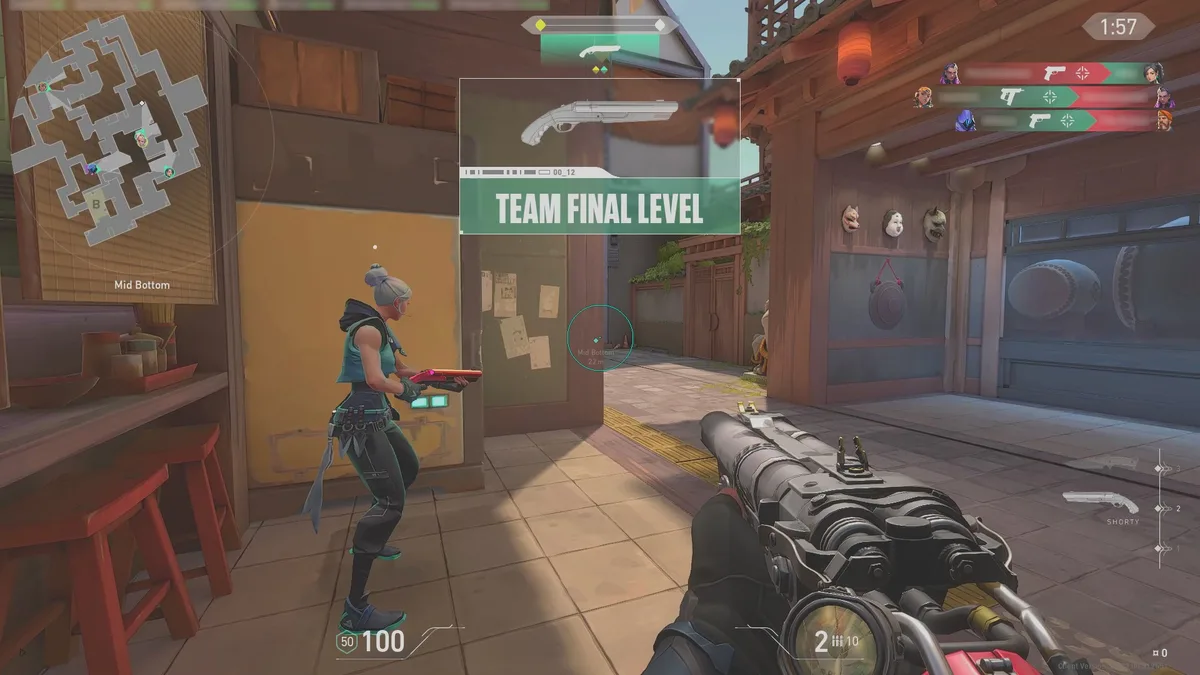
Escalation, when offered on PC, is about advancing through a team weapon ladder. You must complete its twelfth level to win early; merely reaching the final weapon doesn't finish the match. Riot's estimate is seven to nine minutes, with a ten-minute gameplay limit.
Skirmish formats and availability
The matchmade Skirmish 2v2 format introduced in Patch 12.03 is first to ten, without an economy or Agent Select. Its roughly five-to-ten-minute estimate is useful for planning a quick duel session, not a hard cap. Check the mode currently offered: Custom Skirmish settings and later variants need not use identical timers.
Skirmish: Ascension's advertised ranked challenge ran from April 29 to June 22, 2026. That reward program has ended, and its ability rules shouldn't be assumed to apply to standard Skirmish. Retake and other rotating playlists also need a fresh availability check before you queue.
The match timer isn't your whole evening
Your total commitment starts before the first round: matchmaking, Agent Select where applicable, loading and any mode-specific warm-up all take time. A warm-up routine you choose to do before queueing is another separate activity. Results screens and returning to the lobby add a final transition.
There isn't one dependable queue-time allowance for every server, skill bracket, party and time of day. Watch the current queue estimate, but don't treat it as a reservation. Updates, connection problems or another player's loading delay can also upset a tight schedule.
To build a useful personal estimate, record both when you start queueing and when you're free again. Keep match time separate, and note overtime, surrender or a remake. A handful of your own sessions can help you budget for your usual queue, but it won't establish a global VALORANT average.
Why some rounds take much longer than others
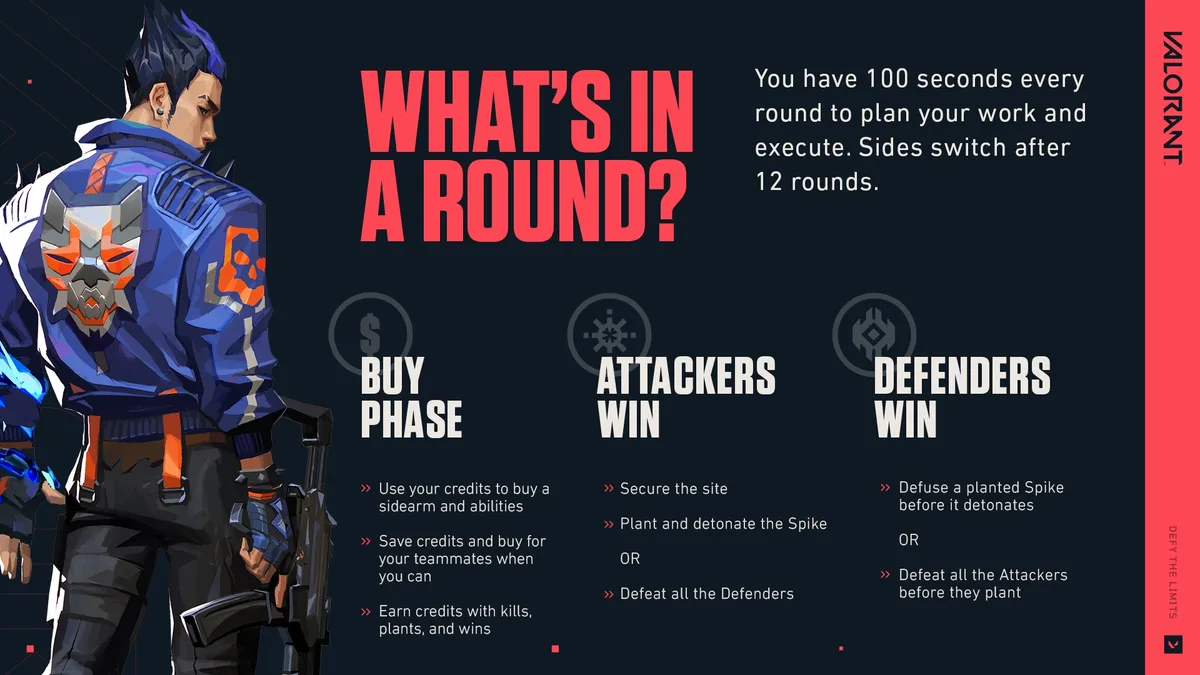
A standard round has a buy phase before its 100-second action clock. Ordinary buy phases are 30 seconds, with longer half-opening preparation. But rounds don't have to use the full clock: an early decisive fight can end one quickly, while a cautious approach and late plant can extend it.
Planting takes four seconds and must complete during the active round. Once planted, the Spike's 45-second detonation countdown replaces the remaining round clock. A full defuse takes seven seconds within that countdown, with a checkpoint halfway through. Forty-five seconds is not the time required to defuse.
That overlap matters. Don't add 100 seconds, four seconds to plant, 45 seconds of detonation time and seven seconds to defuse as though every round contains four consecutive phases. Nor does killing the last attacker necessarily end a round after the Spike is planted: defenders still have to resolve it.
The scoreline, early fights, late plants, overtime and pauses are the useful variables. We haven't found a suitable current dataset supporting precise claims that a particular rank, map or Agent adds a fixed number of minutes. Pick a mode for its format, not an unsupported “fastest map” average.
Can a match end early?
Yes, but surrender and remakes aren't scheduling tools. Riot's current surrender guidance allows a request after the fourth round of a half starts. Unrated needs 80% agreement; Competitive needs unanimity. A team gets one attempt per half, and an accepted surrender ends the match at the start of the next round.
A qualifying first-round AFK can trigger an automatic remake vote. Since Patch 10.00, that vote uses a majority of the remaining players—three of four when one player is absent. It isn't an option to restart any match whenever someone needs to leave.
For ordinary team queues, plan to stay until the match ends. Don't go AFK, dodge, throw rounds or pressure teammates into surrendering to beat a deadline. The useful exception for flexible practice is FFA Deathmatch's documented early-leave policy. Custom lobbies also let you leave through the match menu, but agree on the session with your group rather than abandoning a scrim.
Quick answers
Is Unrated shorter than Competitive?
Not necessarily during regulation: both use the same full-length format. The important difference is a tie. Unrated has one decider at 12–12, while Competitive can continue through repeated overtime pairs.
What's the shortest mode?
There isn't one winner for every platform and playlist. Skirmish 2v2 is estimated at five to ten minutes when offered; Spike Rush and Retake are other short choices. For an exact stopping time, The Range or FFA Deathmatch's early-exit option matters more than which match has the lowest estimate.
Can a VALORANT match last more than an hour?
Yes. Close Competitive games with repeated overtime can exceed an hour. Premier or Custom sessions can also run long because of pauses or multiple games. An unverified “longest ever” record isn't a useful limit for deciding when to queue.
1v9 VALORANT services
Separately from this timing guide, 1v9 lists VALORANT accounts, VALORANT boosting services, VALORANT coaching and VALORANT Points top-ups. These commercial offerings don't change match timers or guarantee shorter queues, matches or wins, and they aren't endorsed by Riot. Review Riot's account and competitive-integrity rules before buying a service.
Sources and update note
The rules were checked against Riot's latest published patch, 13.05, the current support pages linked above, and these mode references:
- Riot's Swiftplay format and approximate duration; Spike Rush rules.
- Deathmatch's nine-minute limit; Team Deathmatch timer and tie rules; Escalation's final-level and timer rules.
- Retake's introduction; matchmade Skirmish 2v2; Ascension event dates; updated remake voting.
- Community-maintained VALORANT Wiki mode reference for supplemental estimates and platform coverage; its Spike mechanics reference for plant and defuse timing. The wiki is not Riot-authored documentation or a match-duration dataset.
September 12, 2026: checked current mode rules, separated gameplay clocks from session estimates, and reconciled Premier overtime, remake voting and the ended Ascension event. Image captions identify older Riot material; no current client session or queue-timing test is claimed.
Posted On: September 12th, 2026
Recent Articles


Our 1v9 support team is available 24/7 to help you with any questions or issues you may have.
support@1v9.gg

-a6d5b3e156bb.webp)





Loading...
1v9.gg is not endorsed or affiliated by any game developers or publishers.
2026 1v9, All Rights Reserved, Created By Ritesh (riteshsahoo.com)