
For Call of Duty: Warzone, keep the NVIDIA Control Panel close to default, set a per-game power profile, and let the game’s NVIDIA Reflex option control the render queue.
Warzone supports NVIDIA Reflex; use the in-game Reflex control and leave NVIDIA Control Panel Low Latency Mode off. The old advice to force every option to “High performance” globally can worsen image quality, waste power, and interfere with other games.
Updated: August 14, 2026
Setting names and current Reflex guidance were rechecked. Live patches can rename or move individual game options.
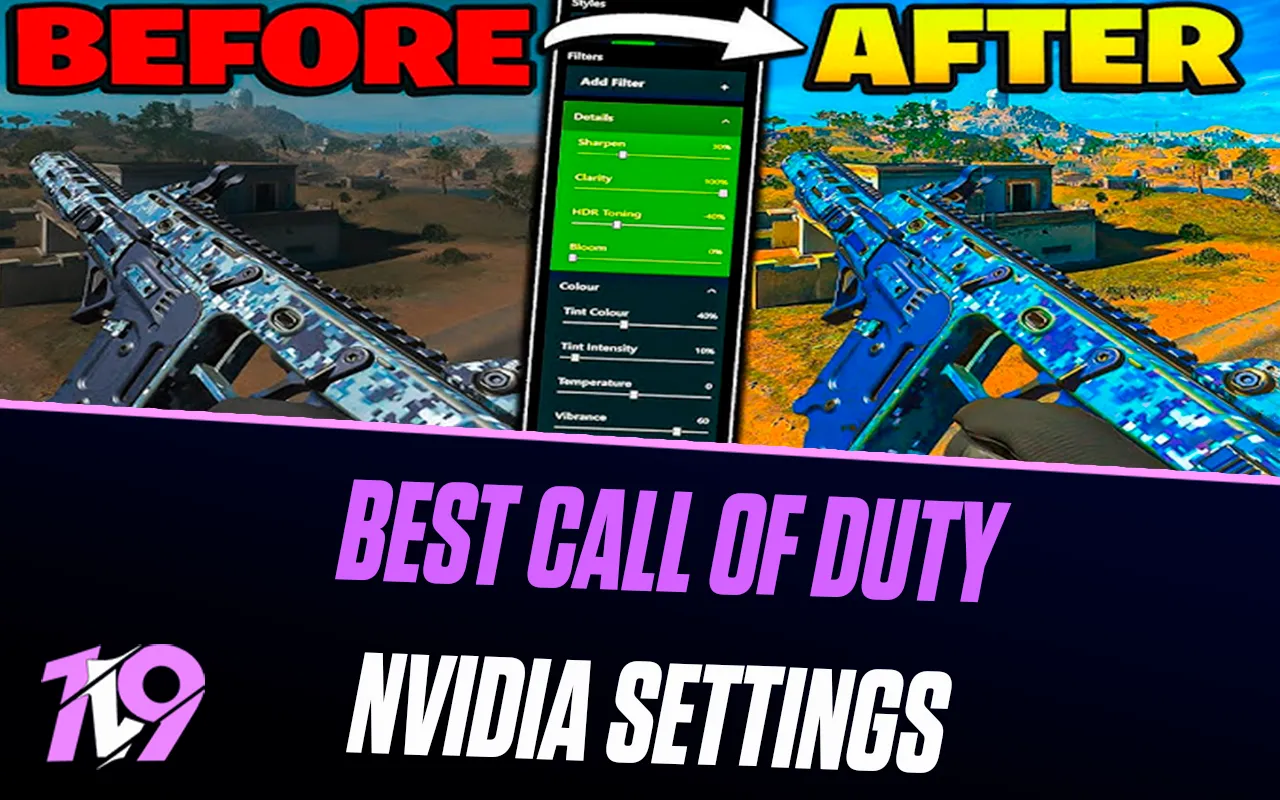
Best Call of Duty: Warzone settings at a glance
| Setting | Recommended starting point |
|---|---|
| Display mode | Fullscreen Exclusive when stable |
| NVIDIA Reflex | On + Boost |
| V-Sync | Off |
| Upscaling | Native or DLSS Quality; lower only when GPU-limited |
| Texture resolution | Normal; reduce if VRAM-limited |
| Shadows and volumetrics | Low |
| On-demand texture streaming | Off for consistency / limited if you prefer quality |
| Frame cap | Match your thermal and display target |
NVIDIA Control Panel settings
| Control Panel option | Recommended value | Reason |
|---|---|---|
| Preferred refresh rate | Highest available | Prevents a low-refresh mode when the game does not choose correctly |
| Power management mode | Prefer maximum performance (per game) | Avoids downclock behavior while this game is active |
| Low Latency Mode | Off when Reflex is enabled | Reflex manages the queue inside the game engine |
| Vertical sync | Off for uncapped competition; On in Control Panel for a G-SYNC capped setup | Choose one coherent sync strategy |
| Max Frame Rate | Off, or cap for G-SYNC/thermals | A deliberate cap can smooth load and keep FPS inside VRR range |
| Texture filtering – Quality | Quality | Avoid needless visual degradation from global High Performance |
| Threaded optimization | Auto | Lets the driver choose when applicable |
| Shader Cache Size | Driver Default | Increase only for a diagnosed cache issue and sufficient disk space |
G-SYNC setup without conflicting advice
- Enable G-SYNC for fullscreen (and windowed if you use it reliably).
- Turn V-Sync on in NVIDIA Control Panel and off in game.
- Cap the frame rate a few FPS below the monitor maximum—for example, 237 on 240Hz.
- Keep Reflex enabled in game when available.
- If you prefer the absolute lowest uncapped latency and accept tearing, disable both G-SYNC and V-Sync instead.
How to tune Call of Duty: Warzone after the baseline
Change one group at a time and test a real match or repeatable benchmark. If GPU utilization is near full and latency rises, lower GPU-heavy effects or use an appropriate upscaler. If utilization is low while FPS stalls, the CPU, game engine, cap, or memory may be the limit.
- Keep the display resolution native unless you deliberately use a competitive stretched mode supported by the game.
- Turn motion blur and film-like post-processing off for clarity.
- Do not use frame generation for competitive latency-sensitive play.
- Record average FPS, 1% lows, GPU usage, and temperature—not only the highest number.
Windows and display checks
- Confirm the maximum refresh rate under Windows Advanced display.
- Use Game Mode unless it causes a repeatable issue on your system.
- Close overlays or recording tools only when testing shows a frame-time problem.
- Update the GPU driver, but do not install a new driver minutes before a tournament.
- Use a direct monitor connection and a cable rated for the resolution/refresh target.
Why this guide avoids “magic” tweaks
Many viral settings lists change undocumented flags, disable useful caches, or repeat advice from older drivers. This guide uses reversible per-game settings and current engine features. It does not promise free FPS from unrelated Windows registry edits.
If hardware remains the limit, read our Call of Duty: Warzone hardware or performance guide.
Call of Duty: Warzone NVIDIA settings FAQ
Should Low Latency Mode be Ultra?
Not when NVIDIA Reflex is enabled in the game. Leave the driver setting off and use Reflex. For a game without Reflex, Ultra can be tested in a per-game profile.
Should V-Sync be on or off?
Off for an uncapped lowest-latency setup. For a tear-free G-SYNC setup, use Control Panel V-Sync on, in-game V-Sync off, and a cap below refresh.
Does “Prefer maximum performance” increase FPS?
It keeps clocks from dropping aggressively while the game profile is active. It does not create performance beyond the GPU and can increase idle power during the game.
Primary sources
Settings are a tested starting logic, not a guaranteed FPS result. Driver, game patch, CPU, GPU, monitor, background software, and personal visual preferences change the best final configuration.


-a6d5b3e156bb.webp)