

VALORANT Corrode Map Guide: Callouts and Strategy
Corrode is a two-site, three-lane VALORANT map built around layered site entries, contested Mid space, and sound-sensitive rotations. In Patch 13.05 it is not in Competitive or Deathmatch: Riot removed it from those queues in Patch 12.05. You can still learn it in supported non-Competitive modes and Custom games, and Riot added it to Retake in Patch 13.02.
Last verified:
How Corrode's layout changes the round
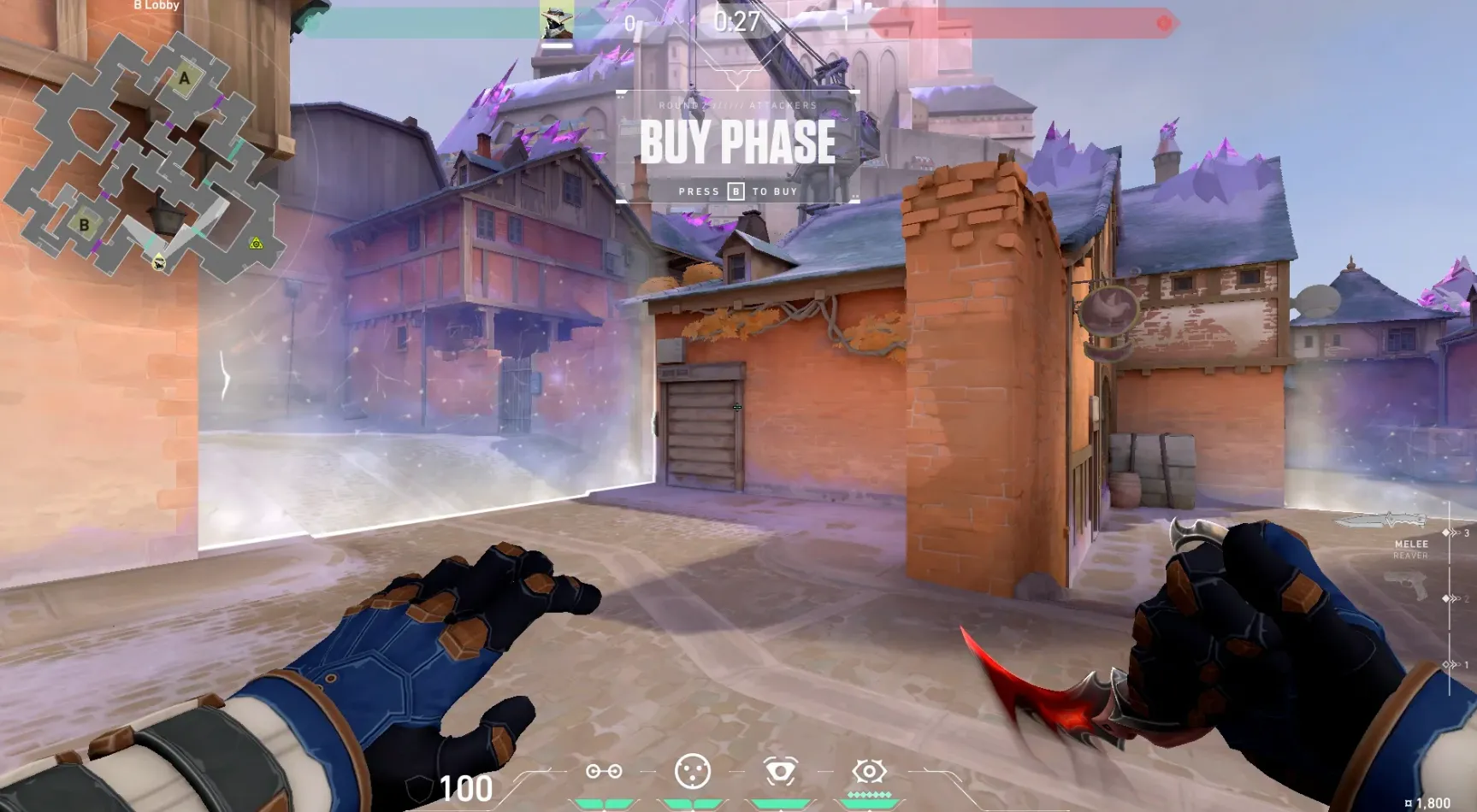
Riot describes Corrode as a traditional three-lane map set in a French castle town converted into a radianite salt-mining facility. A and B are the Spike sites, while the central lane creates pressure between them. The important detail is not simply “take Mid.” It is what Mid control lets your team do next: split a site, threaten a faster rotation, or hold a defender in place while the main group executes.
- Layered entries: the first cleared corner is rarely the entire site. Utility and crosshair placement must move in stages.
- Vertical sightlines: call the elevation as well as the area. “B Tower” is more useful than “B.”
- Long and short fights: Mid can reward a scoped rifle, while Elbow, Pocket, and site cover can collapse the duel to close range.
- Audible movement: water can reveal careless movement. Sound is information, but never assume one footstep proves the full team is present.
Corrode's sites also received targeted wall-material changes in Patch 12.00. Old clips showing effortless high-penetration denial through A- or B-site surfaces may no longer work. Recheck any wallbang in a Custom game before building a round around it.
Essential Corrode callouts
| Area | High-value callouts | What the call should communicate |
|---|---|---|
| A approach | A Lobby, A Main, A Yard, A Pocket | How far the attackers have progressed and which first layer remains uncleared |
| A Site | A Site, A Crane, A Elbow, A Link | Site elevation, the close bend, and the defender connection used for help or retake |
| Mid | Mid Bottom, Mid Stairs, Mid Top, Mid Window | Vertical position and whether a player can pressure a site connection or rotation |
| B approach | B Lobby, B Main, B Elbow | The depth of the main hit and whether close cover has been cleared |
| B Site | B Site, B Arch, B Tower, B Link | High-ground pressure, the arch-side angle, and the route defenders use to reinforce |
A good call combines location, count, and direction: “two Mid Bottom moving up,” or “Operator B Tower, fell back.” Do not turn a location into a biography. Your teammate needs the next decision before the information expires.
How to attack Corrode without feeding the first angle
Start with a default that has a question
Spread safely enough to learn which lane the defenders contest, but decide what the default is trying to discover. A useful opening might preserve one flank watcher, place two players where they can trade Mid contact, and keep the remaining pair ready to punish site aggression. If nobody can say what information ends the default, the team is only waiting.
Use Mid to create a second timing
Mid pressure becomes valuable when it changes the site defender's crosshair. Smoke or flash the long defender angle, clear the next elevation, then pause long enough for the main group to reach its entry position. Five players walking through Mid is not automatically map control; one player surviving in a useful connector can create more pressure than a noisy crowd.
Attack A in layers
- Clear or displace the A Main and Yard defenders before using entry movement.
- Block the sightline that stops the planter or the second player—not every visible doorway.
- Use recon, a drone, a flash, or damaging utility on Pocket and Elbow rather than dry-clearing both at once.
- Keep a rifle in position to trade the entry and another player aware of the A Link retake path.
Treat B as a utility budget
B's approach can expose an entry to several heights and close pockets. Decide before the barrier which tool clears the close layer, which covers Tower or Arch, and which survives for the post-plant. Throwing every grenade and flash at B Main can win the doorway yet leave the team with no answer to the retake.
How to defend Corrode without over-rotating
- Fight for information, not a mandatory duel. A defender can use one piece of utility, report the response, and fall to a tradeable site position.
- Layer the delay. Avoid stacking a slow, smoke, trap, and grenade at the same second. Make attackers solve one problem, then present the next.
- Hold a Mid recovery plan. If the first contest is lost, decide whether the team re-clears with two players or concedes it and tightens both site connections.
- Rotate on confirmation. Utility noise at A Main does not prove the Spike is there. Look for Spike sighting, multiple bodies, committed ultimates, or a broken deep trap.
- Preserve retake utility. A Controller smoke or Initiator clear used after the plant often matters more than a speculative barrier-round throw.
When playing an off-angle, know the exit before taking contact. Corrode's stacked sightlines can make a clever position impossible to escape once two attackers swing at different heights.
Plant, post-plant, and retake priorities
| Phase | Priority | Avoid |
|---|---|---|
| Plant | Choose a spot your surviving players can actually defend; clear the planter's closest threat first | Forcing a “default” plant while Tower, Elbow, or Link has not been checked |
| Post-plant | Build two tradeable angles and keep objective-denial utility on a clear timer | All survivors hiding in the same lane where one smoke isolates them |
| Retake | Regroup, clear one elevation at a time, and pressure the strongest post-plant crossfire together | Five separate one-versus-one peeks before the defuse clock forces action |
| Save decision | Compare health, weapons, credits, ultimates, and remaining time | Assuming every site loss requires a low-percentage retake |
Which Agents and weapons fit Corrode?
A balanced Corrode lineup normally needs repeatable cover, safe information, entry or displacement, and reliable flank or route control. Omen can cover and flash layered approaches; Fade or Sova can clear without donating a rifle; Raze can displace close holders; and Cypher, Killjoy, or Sage can reduce the routes defenders must watch. These are functions, not mandatory names. The current Corrode Agent guide handles the narrower composition question.
For weapons, rifles remain the most flexible baseline because one round can move from a long Mid duel to a close site clear. The Operator is powerful only when its holder has an exit or teammate support. Shotguns reward a known tight engagement but become a liability if the enemy can hold range. High-penetration weapons still have uses, but Patch 12.00 changed key Corrode surfaces, so test the material instead of trusting old footage. Compare current costs and breakpoints in the VALORANT weapon guide.
Five mistakes that make Corrode harder
- Calling only the site. Add Tower, Elbow, Link, or another exact layer so a teammate knows where to aim.
- Equating Mid presence with Mid control. You need a cleared path, a player or utility holding it, and a reason for the pressure.
- Running through water during a lurk. Slow movement and timing matter; sound can reveal the route before the player is seen.
- Clearing two elevations with one crosshair. Slice the angle and let utility remove one possibility. The angle-clearing guide explains the movement.
- Copying a wallbang from launch footage. Verify it after the 2026 material update in a safe Custom game.
Corrode is easier to read when the minimap shows the full team shape without shrinking labels beyond recognition. Use the map-settings baseline and adjust it for your own display.
Frequently asked questions
Is Corrode in Competitive VALORANT?
No. Riot removed Corrode from Competitive and Deathmatch in Patch 12.05 on March 17, 2026. Patch 13.02 later added it to Retake. Check the current VALORANT map directory for the live seven-map pool and other mode distinctions.
How many sites and lanes does Corrode have?
Corrode has two Spike sites and three lanes. Riot described that layout when the map launched in Patch 11.00.
Do attackers have to take Mid on Corrode?
No. Mid is a tool, not a round requirement. Pressure it when doing so opens a split, catches a rotation, or forces defensive utility. A direct site hit can be stronger when the defense has over-invested in Mid.
How should I practice Corrode before it returns to ranked?
Walk the map in a Custom game, learn the official labels, rehearse one A path and one B path, and verify any utility or penetration lineup. Then use Retake or another available queue for live objective timing. Pair that with deliberate crosshair-placement practice.
What is the best weapon on Corrode?
There is no single Corrode-only best weapon. The Vandal and Phantom cover the broadest mix of ranges; an Operator can control a prepared long angle, while a shotgun needs a deliberately forced close fight. Credits, armor, and the next round still decide the correct purchase.
Update log
- Updated for Patch 13.05 with current mode status, Retake availability, accessible callouts, wall-material warning, and attack, defense, and objective plans.
- Riot added Corrode to Retake in Patch 13.02.
- Riot removed Corrode from Competitive and Deathmatch in Patch 12.05.
- Riot adjusted wall materials on key A- and B-site surfaces in Patch 12.00.
Use Riot's latest official patch notes as the final authority if the in-client map list changes.
Posted On: May 15th, 2026
Recent Articles


Our 1v9 support team is available 24/7 to help you with any questions or issues you may have.
support@1v9.gg

-a6d5b3e156bb.webp)





Loading...
1v9.gg is not endorsed or affiliated by any game developers or publishers.
2026 1v9, All Rights Reserved, Created By Ritesh (riteshsahoo.com)