- Home
Games
 League of Legends
 Valorant
-a6d5b3e156bb.webp) Fortnite
Fortnite Call of Duty
 Clash of Clans
 Counter-Strike 2
 Roblox
 Rainbow Six Siege
 Clash Royale
 Minecraft
 Rocket League
 Dota 2
 Genshin Impact
 Squad Busters
 Rust
Rust Apex Legends
 Pokemon Go
 XDefiant
 LoL: Wild Rift
 Hay Day
 Diablo 4
 FC 25
FC 25 Marvel Rivals
 World of Warcraft
 Destiny 2
 Deadlock
-9ede9dc6b01b.webp) PUBG Mobile
PUBG Mobile The Finals
 Growtopia
 Forza Horizon 5
 Honkai: Star Rail
 Warframe
 8 Ball Pool
 Zenless Zone Zero
 Path of Exile
 Runescape 3
 Raid: Shadow Legends
 Lost Ark
 WoW: Classic Era
 Summoners War
 WoW: Season of Discovery
 WoW Cataclysm
 WoW: Hardcore
 Throne and Liberty
 New World
 Mobile Legends
 Escape From Tarkov
 Path of Exile 2
 Blade Ball
 Fisch
Fisch Pet Simulator 99
 Pets Go
-d8bcef7708c7.webp) One Piece Bounty
One Piece Bounty Anime Adventures
 Blox Fruits
 Adopt Me
 Murder Mystery 2
 Fragpunk
 Wuthering Waves
 Teamfight Tactics
 Free Fire
 Albion Online
 Black Desert Online
 Honor of Kings
 Brawl Stars
 Arena of Valor
 Call of Duty: Mobile
 Rematch
 Steal a Brainrot
 Grow a Garden
 FC 26
FC 26 Old School Runescape
 Plants vs Brainrots
 Overwatch
 Battlefield
 Arc Raiders
 Dragon Ball Legends
 Fallout 76
 Jailbreak
 Type Soul
 GPO
GPO DonutSMP
 Escape Tsunami For Brainrots
 Watcher of Realms
 Roblox Rivals
 2XKO
2XKO Sailor Piece
 Forza Horizon 6
 GTA 5
GTA 5- Lootboxes
- Become Affiliate
- Blog
- Contact Us
- Sign In

How to Appeal a League of Legends Ban (Step by Step)
League of Legends has a massive global player base, with games being played every minute across many different servers. To keep matches fair and enjoyable, Riot Games uses a strict moderation and detection system that monitors behavior such as toxicity in chat, cheating tools, account sharing, and other violations of the game’s rules. Because of this system, some players eventually find themselves facing a suspension or ban on their account.
Bans in League of Legends can vary depending on the situation. Some are short suspensions that last only a few days, while others can be permanent restrictions that completely block access to the account. The exact outcome usually depends on the severity of the violation and whether the account has previous penalties on record.
If you believe a ban was applied incorrectly or want to request a review, Riot does provide an appeal process through their support system. In this guide, we’ll explain how the League of Legends ban appeal process works, the steps required to submit an appeal, and what you should expect after contacting Riot support.
How the League of Legends Ban System Works
Riot Games uses a layered moderation system in League of Legends that combines automated detection with manual reviews. The goal is to keep matches fair and maintain a healthy environment for the millions of players who log in every day. Instead of relying on a single system, Riot monitors behavior through several tools that work together to identify rule violations.
The first layer is automated detection. Riot’s systems constantly analyze gameplay data, chat logs, and reports submitted by players. These tools are designed to quickly identify common problems such as abusive language, intentional feeding, scripting, or the use of third-party software. When certain thresholds are reached, penalties can be applied automatically without human intervention.
The second layer involves Riot’s support and moderation teams. When players submit reports or appeals, these cases may be reviewed manually by Riot staff. Human reviews help confirm whether the automated system made the correct decision or if additional context needs to be considered.
Because both systems work together, most penalties are issued based on consistent patterns of behavior rather than a single incident. This approach allows Riot to act quickly against clear violations while still giving players a way to request a review if they believe a ban was applied incorrectly.
Types of LoL Bans and What They Mean
Penalties in League of Legends aren’t all the same. Riot applies different punishments depending on how serious the behavior is and whether the player has a history of previous violations. In most situations, the system follows a gradual escalation, where repeated offenses lead to stronger consequences over time.
Here’s a simplified overview of how the punishment system generally progresses:
First Offense – 3-Day Chat Restriction
The first penalty usually limits your ability to communicate in matches. You can still play normally, but your in-game chat access becomes restricted.
Second Offense – 7-Day Chat Restriction
If the behavior continues, the chat restriction becomes longer. Riot increases the penalty duration to reinforce the warning and discourage repeat offenses.
Third Offense – 14-Day Account Suspension
At this stage, the punishment moves beyond chat restrictions. The account becomes temporarily suspended, meaning you cannot log in or play during the suspension period.
Fourth Offense – Permanent Ban
If the violations continue after previous punishments, the account may be permanently banned. A permanent ban removes access to the account indefinitely.
Severe Violations – Immediate Permanent Ban
Certain actions can trigger a permanent ban without any prior warnings. Examples include the use of cheats, scripting software, or extremely abusive behavior.
ID Bans (The Most Severe Penalty)
Beyond standard account bans, Riot has an even more serious enforcement measure known as an ID ban. This type of restriction is extremely rare and typically reserved for players who repeatedly violate Riot’s rules across multiple accounts.
An ID ban means Riot blocks the individual from using any Riot account across their platforms, including League of Legends and other Riot games. Unlike normal bans that affect a single account, this action targets the person rather than the account itself.
Because of how severe it is, ID bans are rarely issued and usually apply only in extreme cases involving repeated misconduct or serious violations of Riot’s policies.
How Riot Instant Feedback System Detects Violations
Most punishments in League of Legends are triggered by Riot’s Instant Feedback System, which works together with the game’s automated moderation tools. When a player receives reports after a match, the system reviews the situation automatically before deciding whether a penalty should be applied.
The system examines several types of information, including match behavior, chat messages, and the player’s previous report history. By analyzing this data, it can determine whether the reported behavior breaks Riot’s rules and what type of punishment fits the situation. This process happens quickly and is designed to identify clear violations without requiring a manual review every time.
Because the system works in real time, penalties are often issued very soon after the match ends. In many cases, players receive a notification within minutes, while others may see the punishment when they log in again later.
It’s also important to understand that not every penalty follows a slow escalation path. While many punishments begin with warnings or temporary restrictions, certain actions can lead to much stronger consequences right away. Extremely harmful behavior, such as hate speech, harassment, or threats toward other players, can trigger a permanent ban immediately, even if it’s the first recorded offense.
Once the Instant Feedback System applies a penalty, it usually remains in place unless Riot determines that the punishment was issued incorrectly. Because of this, bans that are correctly applied are rarely reversed, and repeated negative behavior can eventually lead to permanent account restrictions.
What Behavior Can Get Your League of Legends Account Banned?
League of Legends bans are usually tied to behavior that harms the experience for other players or breaks Riot’s rules. While some penalties come from repeated smaller offenses, others can result in an immediate suspension if the violation is serious enough. The most common causes of bans tend to fall into a few clear categories.
Toxic behavior in chat is one of the biggest reasons players receive punishments. This includes harassment, insults, hate speech, threats, or any discriminatory language directed at other players. Riot’s system also monitors party chat, so abusive messages there can still trigger penalties.
Griefing and intentional feeding is another major issue. This refers to actions meant to sabotage a match, such as purposely dying, refusing to help teammates, or intentionally playing in a way that ruins the game for others.
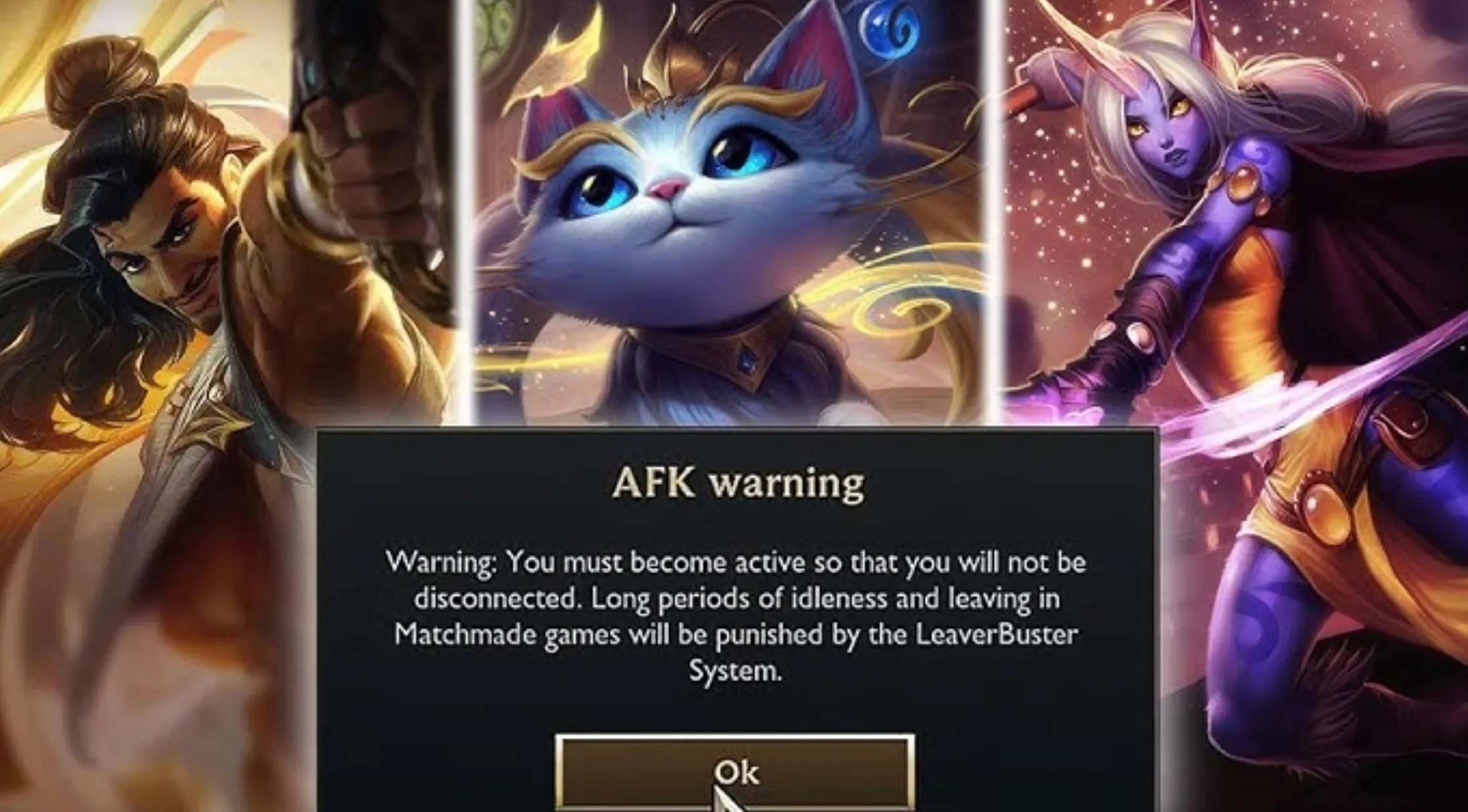
Going AFK or leaving matches repeatedly can also lead to punishments. Riot tracks this through the LeaverBuster system, which automatically flags players who disconnect or abandon games too often.
Cheating tools and scripting software are treated much more seriously. Any program that automates gameplay or provides an unfair advantage usually results in an immediate permanent ban once detected.
There are also several other violations that can lead to account restrictions. These include MMR boosting, where someone else plays on your account to increase your rank, as well as account sharing, which goes against Riot’s rules even if no money is involved. Buying botted or pre-leveled accounts from third-party sellers can also trigger bans if Riot detects how the account was created.
Some players also receive penalties for win trading, which involves coordinating with opponents to manipulate match results, or for intentional deranking, where players purposely lose ranked games to lower their MMR.
Financial violations can also lead to account action. This includes chargebacks, purchasing RP from unofficial sellers, or any fraudulent transaction tied to the account.
Riot has also strengthened enforcement in recent updates by linking penalties across accounts believed to belong to the same player. In practice, this means that if one account receives a serious punishment, other connected accounts may also be affected.
How to Tell If Your League of Legends Account Is Banned
In most cases, players discover a League of Legends ban when they attempt to log in to the game. If an account has received a penalty, the client will display a notification explaining that the account has been restricted, along with the reason and the length of the punishment.
For temporary penalties, the message usually explains that the account has been suspended until a specific date and time. The client may also show examples of chat messages or behavior that triggered the penalty so players can see what caused the action. In many cases, these penalties are connected to abusive communication or repeated reports from other players.
Permanent bans appear differently. Instead of showing a countdown or end date, the notification explains that the account has been permanently restricted due to severe violations of the game’s rules. Once this type of penalty is applied, the account cannot be accessed again unless Riot decides to reverse it after an appeal.
There are also several other signs that may indicate your account has received some type of restriction:
Login access blocked — If the client refuses to let you sign in, your account may be suspended or banned.
Chat restrictions — You can still play matches, but your ability to type in chat is limited or completely disabled.
Honor level suddenly drops — A sharp decrease in Honor level often happens after penalties tied to negative behavior.
Ranked queue disabled — Some punishments temporarily remove access to ranked matches.
VAN 152 error code — This specific error usually indicates a hardware-related ban rather than a normal account suspension.
It’s also worth noting that the terms “ban” and “suspension” are sometimes used interchangeably, but they usually mean different things. Suspensions are temporary penalties that expire after a set time, while bans normally refer to permanent restrictions.
If you cannot log in and no ban message appears, the issue might be account security instead of a penalty. In those situations, Riot recommends starting an account recovery request or contacting support directly to investigate possible unauthorized access.
How to Appeal a League of Legends Ban
If your League of Legends account gets banned, there is still a chance to request a review through Riot’s support system. However, whether the ban gets removed largely depends on the reason it was applied. Riot generally stands by penalties that were correctly issued, but they do allow players to submit an appeal if they believe a mistake occurred.
Short-term suspensions usually resolve on their own once the punishment period ends. More serious restrictions, such as long suspensions or permanent bans, require Riot’s support team to manually review the case. Submitting an appeal gives you the opportunity to explain the situation and ask Riot to take another look at the account.
The appeals that have the highest chance of success are usually cases where the account was compromised, where the automated system may have flagged something incorrectly, or where context around a situation was misunderstood. On the other hand, bans involving clear violations like cheating tools or extremely abusive language are much less likely to be reversed.
When submitting an appeal, it’s important to explain the situation honestly and provide any relevant details that might help Riot understand what happened. Riot’s support team reviews the evidence tied to the account before making a final decision.
Keep in mind that Riot does not negotiate punishments when the violation is clearly confirmed in their records. If the system shows clear evidence of rule-breaking, the penalty usually remains in place. Because of that, submitting an appeal is most useful when there is a legitimate reason to believe the ban was applied incorrectly.
How To The Appeal Process Riot Support
If you believe your League of Legends ban was issued incorrectly, you can request a review through Riot’s official support portal. All appeals must be submitted directly through the Riot support website, where their team will evaluate the case and determine whether the penalty should remain in place.
Here is the typical process for submitting a League of Legends ban appeal:
1. Visit the official League of Legends support website and log in using the account that received the ban.
2. Click Submit a Ticket to open a new support request.
3. Choose the option related to account restrictions, suspensions, or bans.
4. Select the category that matches your situation, usually something related to game bans or account penalties.
5. Indicate the length of the punishment if the form asks for it (for example, temporary suspension or permanent ban).
6. Write your explanation in the ticket description. Clearly explain what happened and why you believe the penalty should be reviewed.
7. If you have helpful proof, attach it to the ticket. This could include screenshots, proof your account was compromised, or other relevant information.
8. Submit the request and wait for Riot’s support team to respond.
Riot usually replies within a few business days, although response times can vary depending on how busy their support queue is. Straightforward cases, such as compromised accounts, may be resolved fairly quickly, while more complicated situations can take longer.
After sending the appeal, it’s best to wait for the response instead of creating multiple tickets, since opening new requests can delay the review process. Also check your spam or junk folder in case Riot’s reply ends up there.
What to Include in Your League of Legends Ban Appeal
The way you write your League of Legends ban appeal can make a big difference in how Riot reviews your case. A well-structured appeal that explains the situation clearly and includes useful evidence gives you the best possible chance of getting the penalty reviewed.
A good appeal should focus on facts rather than emotions. Riot’s support team already has access to match records, chat logs, and other data tied to the account, so providing clear context and supporting information is far more effective than writing a long complaint.
Here are some things that can strengthen a League of Legends ban appeal:
A clear explanation of the situation
Explain why you believe the ban was applied incorrectly. Be specific about what happened instead of giving vague statements.
Relevant match or chat context
If the penalty was related to chat or in-game behavior, providing context from the match can help clarify the situation.
Proof related to account activity
For cases involving account compromise or unusual activity, include any emails, login alerts, or security notifications that show what happened.
Purchase receipts or payment information
If the ban is connected to payment issues such as chargebacks or gifting problems, attaching store receipts or transaction records can help support your claim.
Steps taken to secure the account
Mention any actions you’ve taken to protect the account moving forward, such as changing your password or enabling two-factor authentication.
When writing the appeal, keep the message clear and respectful. A short explanation that focuses on the facts is usually more effective than a long message filled with frustration. Riot’s support staff will review the account data before making a final decision, so honesty and transparency generally lead to the best outcome.
What Makes a LoL Ban Appeal Succeed or Fail?
Whether a League of Legends ban appeal succeeds usually depends on one key factor: whether Riot’s system made a mistake or not. Riot’s moderation tools are generally accurate, but errors can still happen. When a player provides clear evidence that a penalty was applied incorrectly, there is a chance the support team may reverse the decision after reviewing the case.
Appeals tend to have a better chance of success when there is a reasonable explanation supported by evidence. For example, one of the most common successful cases involves account compromise, where another person gained access to the account and caused the violation. If Riot can verify that the account was accessed from unusual locations or devices, the penalty may be reconsidered.
Another situation where appeals sometimes succeed is when automated detection systems misunderstand context. In rare cases, chat messages may be interpreted incorrectly, or the system may flag a match as intentional feeding when it was simply a very poor performance. Providing additional context around the match can help Riot evaluate the situation more accurately.
Appeals can also work when financial issues are resolved, such as chargebacks or payment disputes. If the account was temporarily restricted while a payment problem was investigated and the issue has since been corrected, Riot may restore access after reviewing the documentation.
However, there are also many cases where appeals rarely succeed. If the account has multiple prior warnings or punishments for the same behavior, Riot is much less likely to reverse the penalty. Clear violations such as hate speech, harassment, threats, or discriminatory language are also taken very seriously and are rarely forgiven once confirmed in the logs.
Likewise, bans related to cheating software, scripting tools, or other third-party programs are extremely difficult to overturn, since Riot has strict policies against anything that provides an unfair advantage. The same applies to confirmed cases of account boosting or account sharing, which go directly against Riot’s rules.
Permanent bans are the hardest penalties to reverse, but temporary suspensions sometimes have a better chance if the appeal is respectful and supported by clear information. A calm explanation of what happened, combined with relevant evidence, gives Riot the best reason to review the decision.
How to Avoid Getting Banned in League of Legends Again
Permanent bans in League of Legends rarely happen because of a single match. In most cases, Riot’s system detects a pattern of repeated behavior over time. Because of that, making a few simple changes to how you play and interact with others can greatly reduce the chances of receiving another penalty.
One of the easiest ways to avoid problems is limiting or disabling chat. Many punishments in League come from toxic communication during stressful matches. Muting players early or turning off chat entirely removes the risk of saying something that could later be reported.
It’s also important to stay in matches until they end, even when the game is going badly. Leaving games early or repeatedly going AFK is tracked by Riot’s systems and can lead to escalating penalties if it happens often.
Another key rule is never sharing your account with other players. Allowing someone else to play on your account, even a friend, can create problems if they break the rules while using it. Riot has also strengthened enforcement across connected accounts, so violations tied to one account may affect others linked to the same player.
Players should also avoid any third-party tools that interact with the game client. Programs that modify gameplay or provide advantages can trigger automatic bans, even if they seem harmless. Riot’s systems are designed to detect software that interferes with the game.
If you encounter bugs or exploits in the game, the safest option is to report them instead of abusing them. Repeatedly using known exploits can result in suspensions or stronger penalties.
Finally, protecting your account is just as important as following the rules. Enabling two-factor authentication and strong account security helps prevent unauthorized access. If someone else gains access to your account and breaks the rules, it could still lead to penalties tied to your account.
FAQs
Can a permanently banned League of Legends account be restored?
In some situations, yes, but it depends heavily on the reason behind the ban. Appeals are more likely to succeed if the account was compromised or if the system incorrectly flagged the account. However, bans tied to serious violations such as cheating software, hate speech, or repeated misconduct are rarely reversed.
Are permanent bans actually permanent in League of Legends?
In most cases, yes. When Riot confirms that the violation occurred and the penalty was applied correctly, the ban normally stays in place permanently. Riot generally only reverses these decisions if there is clear evidence that the punishment was issued in error.
How long does a hardware ban last in League of Legends?
Hardware bans are among the most serious penalties Riot can apply. In some cases, players may request a review after roughly one year has passed since the ban was issued. Even then, a review does not guarantee that the restriction will be removed.
Does a ban in League of Legends affect other Riot games?
It can. Riot accounts are shared across multiple games, including Valorant and Teamfight Tactics. If a serious penalty is applied to the account, it may impact access to other Riot titles as well. With Riot’s account-linking enforcement, violations tied to one account can sometimes affect other accounts associated with the same player.
Conclusion
Getting banned in League of Legends can be frustrating, especially if you’ve spent years building progress on your account. While not every penalty can be reversed, Riot does provide an official appeal process for players who believe their account was restricted by mistake or compromised by someone else.
The most important step is understanding why the ban happened and submitting a clear, honest appeal through Riot Support. Providing evidence, explaining the situation calmly, and showing that you’ve taken steps to secure your account can improve the chances of your case being reviewed fairly.
Even if an appeal is unsuccessful, knowing how Riot’s ban system works can help prevent future penalties. By following the game’s rules, maintaining respectful behavior in matches, and protecting your account with strong security, you can avoid further issues and continue enjoying League of Legends without risking another ban.
Posted On: March 9th, 2026
Recent Articles


Our 1v9 support team is available 24/7 to help you with any questions or issues you may have.
support@1v9.gg
Loading...
1v9.gg is not endorsed or affiliated by any game developers or publishers.
2026 1v9, All Rights Reserved, Created By Ritesh (riteshsahoo.com)