


Best Wild Rift Settings for 2026
The best Wild Rift settings make target selection deliberate, keep the battlefield readable, and hold a stable frame rate after the phone heats up. Start with Portrait Lock, champion-only target filtering, separate minion and turret buttons, aim panning for long-range abilities, a custom HUD, and the highest FPS tier your device sustains. Graphics quality comes after control reliability and frame pacing.
Best Wild Rift settings at a glance
| Setting | Recommended baseline | Adjust when… |
|---|---|---|
| Portrait Lock | On | Move portraits if they block skill buttons |
| Target Lock Filtering | Champions only | Use dedicated minion/turret attacks for other units |
| Target Priority | Low HP % or Closest | Choose by role, range, and champion kit |
| Aim Panning | On for long-range skills | Disable if camera movement causes lost positioning |
| Graphics Quality | Performance or Custom Medium | Lower effects/shadows when hot |
| FPS | Highest stable supported tier | Drop one tier if long fights stutter |
| Floating Text / Health Bars | On | Reduce only if the screen becomes unreadable |
| Dual-channel network tools | Conditional | Enable only after testing and checking data cost |
Targeting, Portrait Lock, and attack priority
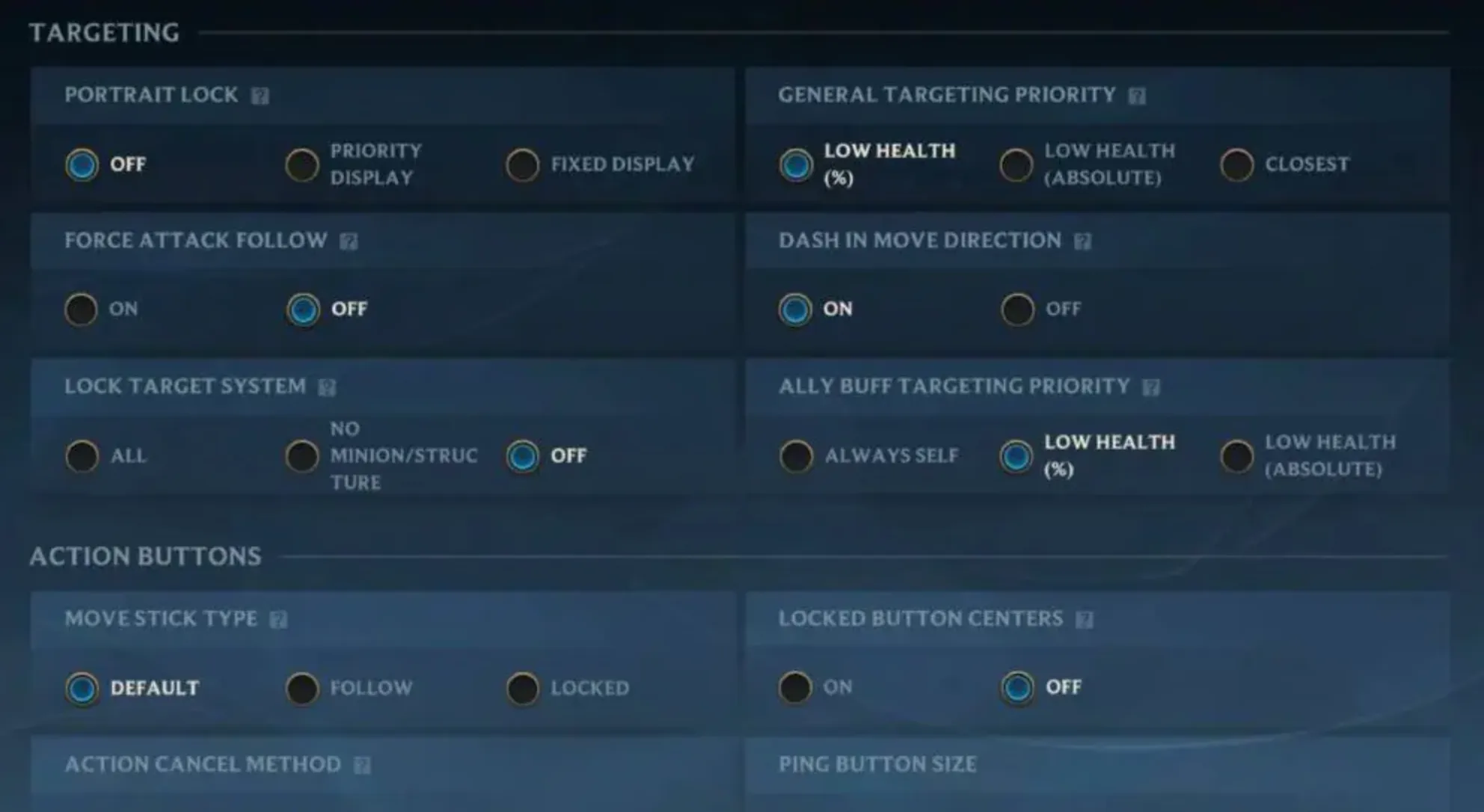
Portrait Lock should be on for most players. Tapping an enemy portrait commits compatible attacks or abilities to that visible champion, which is safer than automatic selection during a crowded fight. Put the portraits where your right thumb reaches them without covering the minimap, active items, or ability buttons.
Enable Target Lock Filtering so target-lock selection ignores minions and towers. Riot introduced the filter specifically to stop mid-fight locks from jumping to non-champion units. Keep the separate minion and turret attack buttons visible; they give you explicit control for last-hits and structure damage.
Which target priority is best?
- Low HP Percentage: a strong marksman and assassin baseline for finishing a damaged target relative to its maximum health.
- Low HP: prioritizes the smallest raw remaining health pool; useful for some burst patterns but not guaranteed to pick the strategically most dangerous enemy.
- Closest: predictable for melee champions, tanks, and players who want taps to answer the nearest immediate threat. Riot's implementation applies to champion targeting.
Automatic priority is the fallback. Drag important skillshots manually and use Portrait Lock when one enemy must be hit. For more champion context, the current Wild Rift tier list by role helps distinguish kits that want close, low-health, or manual selection.
Control layout, skill aiming, and champion controls
Customize the HUD around your actual hand position. Keep movement anchored where the left thumb lands, separate the ability buttons enough to prevent drags from crossing, enlarge Smite/Flash or active items you often miss, and leave space for the cancel zone. Tablets and foldables need a wider layout; a phone preset will bunch controls unnecessarily.
Tune ability-button deadzones so tapping casts reliably while dragging still enters manual aim. A larger deadzone reduces accidental aim drags but demands more thumb travel. Set cancellation to the gesture you can repeat under pressure and make its zone visibly separate from another important button.
Patch 6.1 added a Champion Controls tab. It groups Quick Cast Empowered Attacks, Cast on Button Press, Flash Combo, Manual Aim Time Limit, and champion-specific controls. Use Quick Cast Empowered Attacks on Champion if you want empowered autos to favor champions without firing at every unit. Flash Combo can accelerate supported dash-plus-Flash actions, but manual execution remains easier to diagnose while learning.
Cast on Button Press releases non-aimed actions sooner; leave aimed skillshots on release/manual aim. Manual Aim Time Limit is useful for abilities such as Viktor's Hextech Ray or Rumble's The Equalizer because it displays a countdown while you aim. Review a champion's own settings after a rework instead of assuming the global page controls every mechanic.
Camera, aim panning, minimap, and interface
Enable aim panning for long-range abilities when it shifts the view toward the cast direction and reveals the intended target area. Disable it on champions or players who lose track of their own position during the shift. Set camera-pan sensitivity so one deliberate swipe checks an objective without overshooting it.
Keep the minimap large enough to recognize champion portraits and objective timers at a glance. Enable health bars, cooldown numbers, damage text, ward information, and teammate ultimate/spell timers. Riot's updated interface supports separate HUD, strategy panel, and store transparency; reduce opacity only after confirming it does not hide combat information.

Graphics and FPS settings
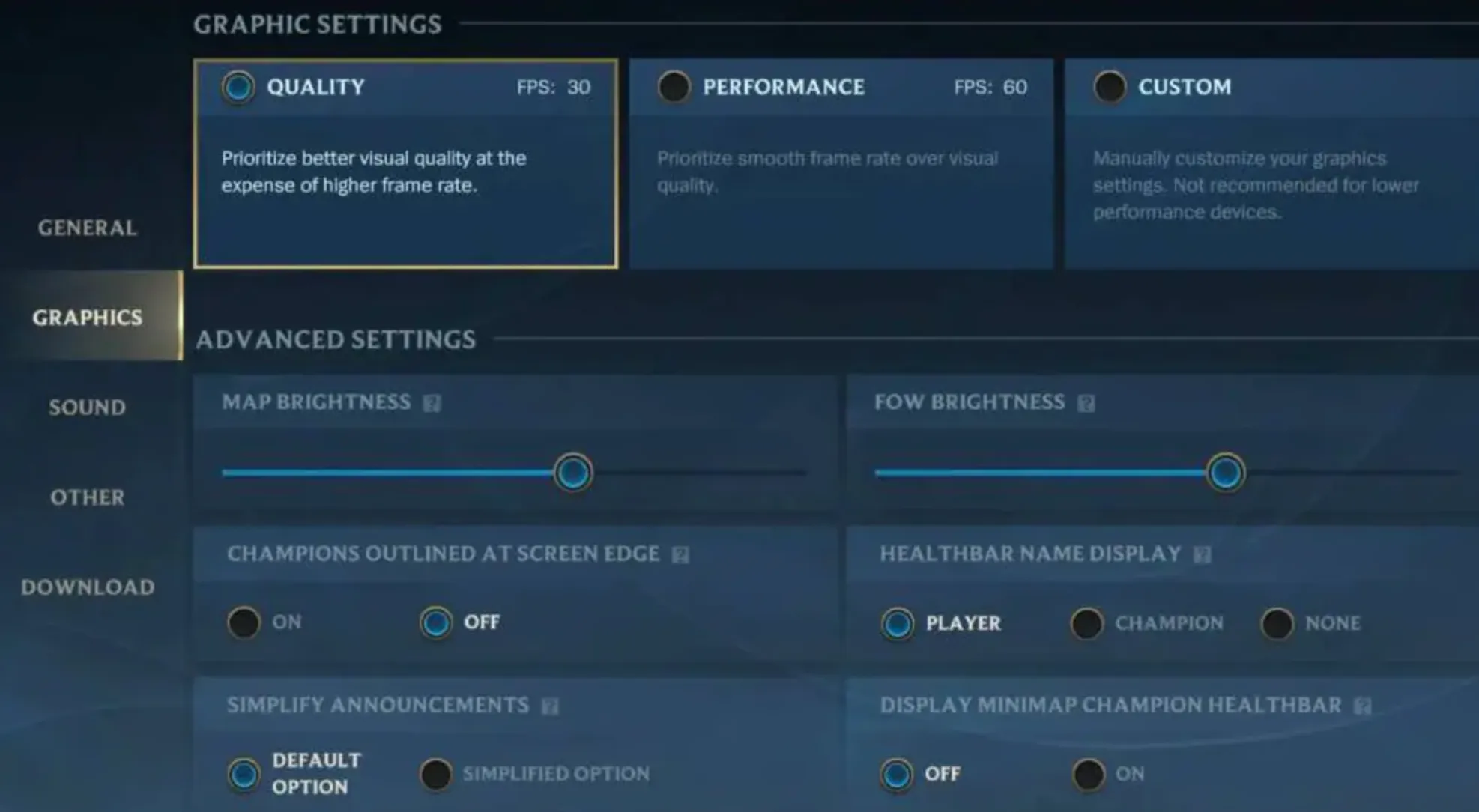
Choose FPS first. Wild Rift has offered 40, 60, 90, and 120 FPS tiers on supported devices, but availability is certified per device and can change. Riot warned when introducing 120 FPS that overheating or performance degradation was possible. A high-refresh screen alone does not guarantee the game exposes the tier.
Use Performance preset or Custom Medium as the baseline. Lower shadows, effects quality, post-processing, and resolution before sacrificing the FPS target. Keep character inking or outlines if they improve champion separation. Anti-aliasing is optional: retain it if shimmering distracts you, disable it when the GPU needs headroom.
Low-, mid-, and high-end phone recommendations
| Device behavior | Graphics | FPS goal | Priority |
|---|---|---|---|
| Low-end / frequent heat | Performance, low effects/shadows | Stable 30/40/60 available tier | Consistency and battery |
| Mid-range / stable 60 | Custom Medium | 60; test higher if offered | Fight-time frame pacing |
| High-end / high refresh | Medium–High selectively | 90/120 if supported and sustained | Cooling over maximum visuals |
Test three consecutive matches. If the first is smooth and the third stutters, thermal throttling—not network ping—may be the cause. Avoid direct sun, heat-trapping cases, and fast charging during ranked sessions. Higher FPS and brightness increase power draw; lower one tier when the battery or surface temperature becomes uncomfortable.
On Android, vendor game modes can block notifications and prioritize performance, while battery optimization may interfere with background voice apps. On iPhone and iPad, use Focus for interruptions and leave Low Power Mode off during performance testing. Neither platform guarantees the same FPS options across every model or region.
Network, sound, quick chat, notifications, and privacy
Use stable nearby Wi-Fi, pause downloads, and avoid network switching mid-match. A dual-channel or network acceleration feature may combine Wi-Fi and cellular data; use it only if the device offers it, your plan permits the traffic, and repeated tests show fewer spikes. It cannot repair every server-route problem.
Keep sound effects high enough for ability and objective cues, reduce music if it masks them, and set voice chat below critical effects. Configure a short quick-chat wheel for retreat, group, enemy missing, objective, and cooldown information. Too many similar messages slow selection.

Use Android gaming mode or iOS Focus to block banners, calls, and floating windows while preserving emergency contacts if needed. Review microphone, photos, contacts, tracking, and notification permissions and keep only features you use. Leave login/security alerts enabled, hide personal identifiers in screenshots, and use Riot's official account recovery tools.
New players can pair these settings with the Wild Rift beginner guide. Optional Wild Rift coaching can address champion-specific control habits separately.
Wild Rift settings FAQ
Should I use Low HP or Closest target priority?
Low HP Percentage is a strong ranged-damage baseline; Closest is predictable for melee and frontline champions. Use Portrait Lock to override either when one enemy matters.
Is 120 FPS always best?
Only when the game supports it on your device and the phone sustains it without harmful heat or repeated drops. A stable lower tier can feel better over a full session.
Should I enable aim panning?
Enable it for long-range abilities if the extra forward view improves aim. Disable it on profiles where camera motion makes you lose your own champion.
Why are 90 or 120 FPS options missing?
Riot exposes high-FPS tiers only on supported device and software combinations. Display refresh rate by itself is not sufficient.
Posted On: September 7th, 2024
Recent Articles


Our 1v9 support team is available 24/7 to help you with any questions or issues you may have.
support@1v9.gg


-a6d5b3e156bb.webp)





Loading...
1v9.gg is not endorsed or affiliated by any game developers or publishers.
2026 1v9, All Rights Reserved, Created By Ritesh (riteshsahoo.com)