


Best CS2 Settings for 2026
The best CS2 settings create a stable, low-latency image without hiding competitive information. Start with fullscreen, your maximum refresh rate, Boost Player Contrast on, V-Sync off, NVIDIA Reflex on, Dynamic Shadows set to All, and FidelityFX Super Resolution disabled. For aim, 800 DPI with 1.0 sensitivity gives a controlled 800 eDPI baseline, while zoom sensitivity can stay at 1.0.
Best CS2 settings at a glance
| Setting | Competitive baseline | Important tradeoff |
|---|---|---|
| Display Mode | Fullscreen | Best control of resolution and refresh rate |
| Refresh Rate | Highest available | Confirm after every resolution change |
| Resolution | Native 16:9 or tested 4:3 stretched | 4:3 removes horizontal information |
| Boost Player Contrast | Enabled | Improves model separation |
| V-Sync | Disabled | Use a deliberate VRR setup if tearing bothers you |
| NVIDIA Reflex | Enabled | Enabled + Boost uses more power and can cost FPS |
| Dynamic Shadows | All | Preserves enemy shadow information |
| Mouse baseline | 800 DPI · 1.0 sens · 800 eDPI | Tune by measured distance, not popularity |
Best CS2 DPI, sensitivity, eDPI, and zoom settings
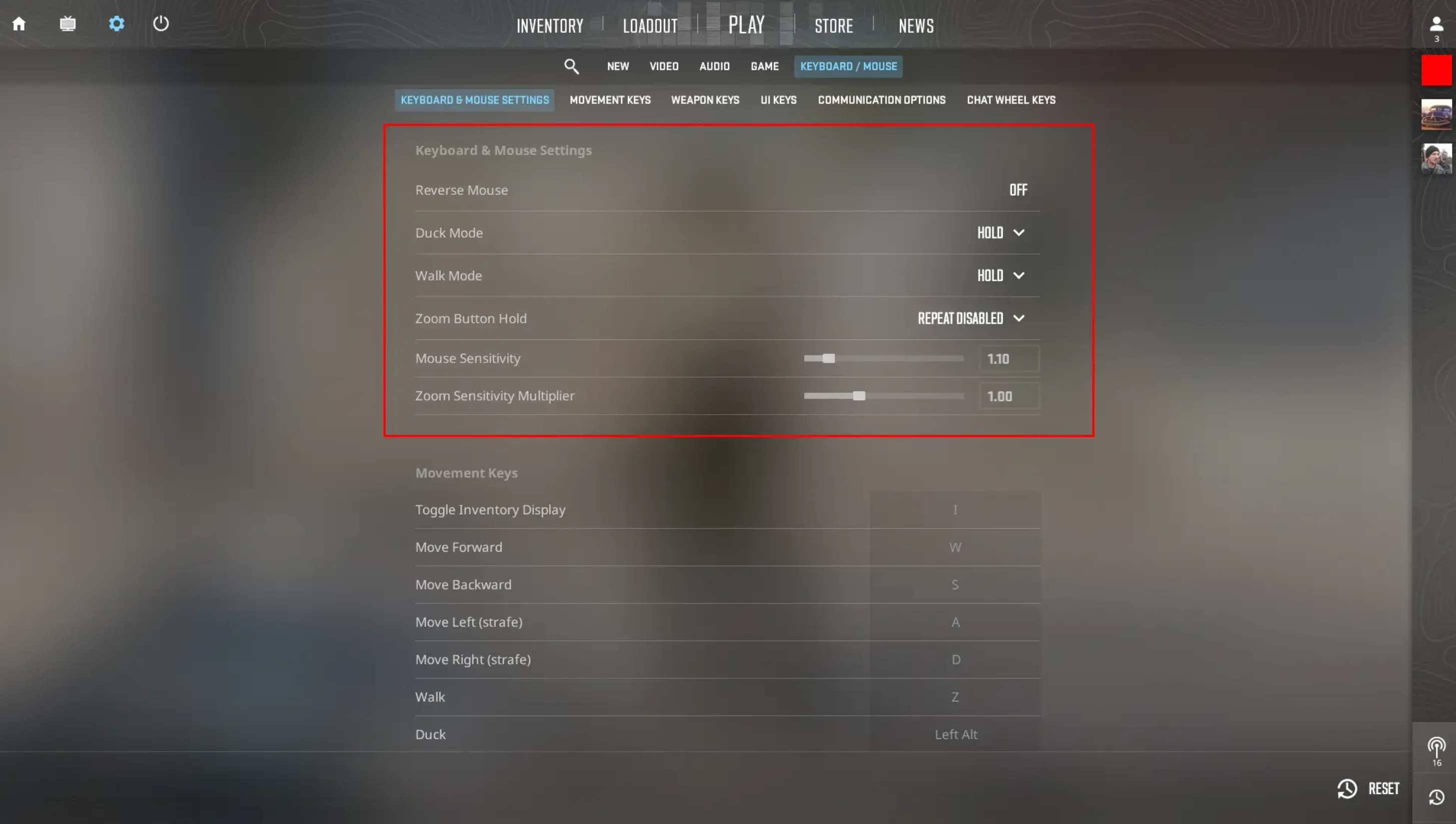
eDPI = mouse DPI × in-game sensitivity. At 800 DPI and 1.0 sensitivity, eDPI is 800. The same turn speed can be produced by 400 DPI × 2.0 or 1600 DPI × 0.5. Start between roughly 600 and 1,200 eDPI, then choose a value that allows one controlled 180-degree turn while preserving small head-level corrections.
Keep Zoom Sensitivity Multiplier at 1.0 until the hip-fire setting is stable. A lower value can help fine AWP or Scout corrections, but it also creates a second sensitivity to learn. Use 1,000 Hz polling as a dependable baseline; 2,000–4,000 Hz is useful only when the mouse, CPU, USB path, and frame rate remain stable.
CS2 uses raw mouse input, so do not install acceleration utilities or reuse old CS:GO registry tweaks. Make one 5–10% change, practice the same recoil and target-switching drill, and keep it only when both improve.
Best CS2 crosshair and viewmodel
Choose Classic Static for a crosshair that does not expand with movement or firing. Start with short lines, thickness 1, a small center gap, full opacity, and a cyan, green, or yellow color visible on every active map. An outline can improve contrast but also makes a tiny crosshair look thicker. Test against bright sky, dark interiors, smoke edges, and player models.
CS2 supports Share or Import codes in the Game > Crosshair menu. Use a copied code only as a baseline; resolution changes alter how the same pixel dimensions feel. The CS2 crosshair customization guide covers every slider and the import flow.
A clear viewmodel keeps the weapon away from important angles without changing recoil, accuracy, or hit registration. A common wide baseline is viewmodel FOV 68 with X 2.5, Y 0, and Z -1.5. If it feels unnatural, use the Desktop preset. Viewmodel changes are visual only; they do not move bullets.
Best radar, HUD, and keybind settings
Turn Radar Centers the Player off so the minimap shows more of the current area. Keep Radar Rotating on if orientation is faster for you, set HUD Radar Scale near 1.0, and use roughly 0.35–0.45 map zoom so teammates, the bomb, and adjacent routes remain visible. The best zoom shows the next rotation without making nearby contacts tiny.
Keep the HUD large enough to read money, utility, ammo, and teammate health at a glance. Use high-contrast team colors and the larger player-count display if those improve recognition. Accessibility settings should solve an actual visibility issue rather than mimic another player's palette.
Bind smoke, flash, HE, and molotov/incendiary to separate reachable keys. Keep push-to-talk, drop, inspect, ping, and jump available without disrupting movement. A dedicated utility layout matters most when paired with repeatable lineups; use the CS2 grenade-practice guide to test it.
16:9 vs 4:3 stretched vs black bars
| Format | Advantage | Cost |
|---|---|---|
| Native 16:9 | Sharpest image and widest horizontal view | Models appear narrower than stretched 4:3 |
| 4:3 stretched | Models look wider; motion feels faster | Loses horizontal information; image is distorted |
| 4:3 black bars | Undistorted 4:3 focus area | Loses horizontal view without wider models |
Stretched resolution does not enlarge hitboxes or change server-side movement. It changes the displayed shape and apparent speed. Use the highest resolution that keeps frame times stable, then stay with one format long enough for flick distance and crosshair scale to feel normal.
Best CS2 video and graphics settings
| Advanced Video option | Recommended | Low-end fallback |
|---|---|---|
| Boost Player Contrast | Enabled | Keep enabled |
| MSAA | 2x or 4x | CMAA2 / None if necessary |
| Global Shadow Quality | High | Low/Medium; preserve Dynamic Shadows All |
| Dynamic Shadows | All | All when competitive information matters |
| Model / Texture Detail | Low or Medium | Low |
| Texture Filtering | Anisotropic 4x | Bilinear/2x |
| Shader / Particle Detail | Low | Low |
| Ambient Occlusion | Medium | Disabled |
| High Dynamic Range | Quality | Performance |
| FidelityFX Super Resolution | Disabled | Quality only when GPU-limited |
NVIDIA documents Reflex Enabled as the strong default. Enabled + Boost can reduce latency further on supported systems but uses more power and may slightly lower FPS; select it only after measuring. AMD users should keep drivers current and test Anti-Lag from a clean per-game profile rather than stacking multiple limiters.
For FPS limits, compare uncapped with a cap the PC holds during smokes, water, and busy executes. Uncapped can minimize render delay, while a deliberate cap can improve frame-time stability, temperature, or VRR behavior. There is no universal number for every monitor and CPU.
Best CS2 audio and communication settings
Select the correct output device explicitly and use headphones or a calibrated stereo setup. Start with the Crisp EQ profile if it makes footsteps easier to separate; switch to Natural if Crisp becomes fatiguing or makes weapons mask direction. Perspective Correction is the modern positional baseline. L/R Isolation changes channel separation, so adjust it gradually instead of copying 100% without listening tests.
Lower menu, MVP, and round music. Keep the ten-second warning audible if it helps bomb decisions. Use push-to-talk, set teammate volume high enough for short calls, and enable Streamlined Push to Talk only if microphone activation causes a measurable hitch. Avoid third-party virtual surround on top of CS2's own spatial mix unless blind testing proves it improves direction.
Useful launch options, Windows, NVIDIA, and AMD settings
Leave Launch Options blank by default. CS2 detects CPU threads and refresh rate itself. Enable Developer Console in Settings > Game; Steam's current support page documents this path. Use an autoexec only when you understand and verify every command. Do not paste old strings containing -high, -threads, -tickrate 128, -nojoy, or forced refresh flags.
In Windows, set the display to its maximum refresh rate, enable Game Mode, keep chipset/GPU drivers current, and close unused overlays or capture tools. In the NVIDIA or AMD control panel, use application-controlled graphics, the highest refresh rate, and a clean CS2 profile. Avoid forcing driver V-Sync or low-latency modes on top of an untested in-game configuration.
A practical CS2 settings test
- Save screenshots of the current menus, crosshair code, and any autoexec.
- Lock resolution, refresh rate, and sensitivity before changing quality settings.
- Test one active-duty map with bots, then Deathmatch, then a real match.
- Record average FPS, poor frame-time moments, GPU utilization, and temperature during smokes and executes.
- Change one category and repeat the same route. Revert anything that improves the counter but harms model clarity or stability.
Settings support mechanics; they do not replace crosshair placement, utility, or round decisions. The current CS2 ranking-system guide explains how those skills translate into Competitive and Premier progress.
CS2 settings FAQ
Is 4:3 stretched better than 16:9?
It makes models look wider but removes horizontal information and does not enlarge hitboxes. Use it only if the presentation improves your consistency.
What eDPI is best for CS2?
Start around 800 eDPI and test roughly 600–1,200. The best value supports small head-level corrections and a comfortable 180-degree turn on your mousepad.
Should NVIDIA Reflex be on?
Yes on supported NVIDIA GPUs. Use Enabled first; test Enabled + Boost only if the small latency gain is worth higher power use or a possible FPS cost.
Does CS2 need launch options?
No. A blank field is the safest default. Add only a current option you understand for a specific workflow.
Posted On: May 29th, 2024
Recent Articles


Our 1v9 support team is available 24/7 to help you with any questions or issues you may have.
support@1v9.gg


-a6d5b3e156bb.webp)





Loading...
1v9.gg is not endorsed or affiliated by any game developers or publishers.
2026 1v9, All Rights Reserved, Created By Ritesh (riteshsahoo.com)