

League of Legends Faelights: Complete Guide
League of Legends has always been a game where information wins fights. Knowing where enemies are, which areas are safe, and when to contest objectives often matters more than raw mechanics. Over the years, Riot Games has adjusted wards, trinkets, and vision rules to keep that balance interesting, and Faelights are the newest addition to that system.
Faelights introduce a fresh way to interact with vision, changing how players gather information and control key parts of the map during a match. They’re not just another small tweak, but a mechanic that can influence rotations, jungle pathing, and objective setups in meaningful ways. In this guide, we’ll explain exactly what Faelights are, how they work in-game, and why understanding them can give you an edge in ranked play.
What Are Faelights in League of Legends?
Faelights are a new vision mechanic introduced to League of Legends with Patch 26.1, designed to shake up how teams gather information on Summoner’s Rift. Instead of being placed by players like regular wards, Faelights appear on the map on their own at fixed locations. Either team can interact with them, and whoever activates one gains temporary vision in the surrounding area. Riot added Faelights to create more active and contested vision points, rather than relying only on trinkets and control wards.
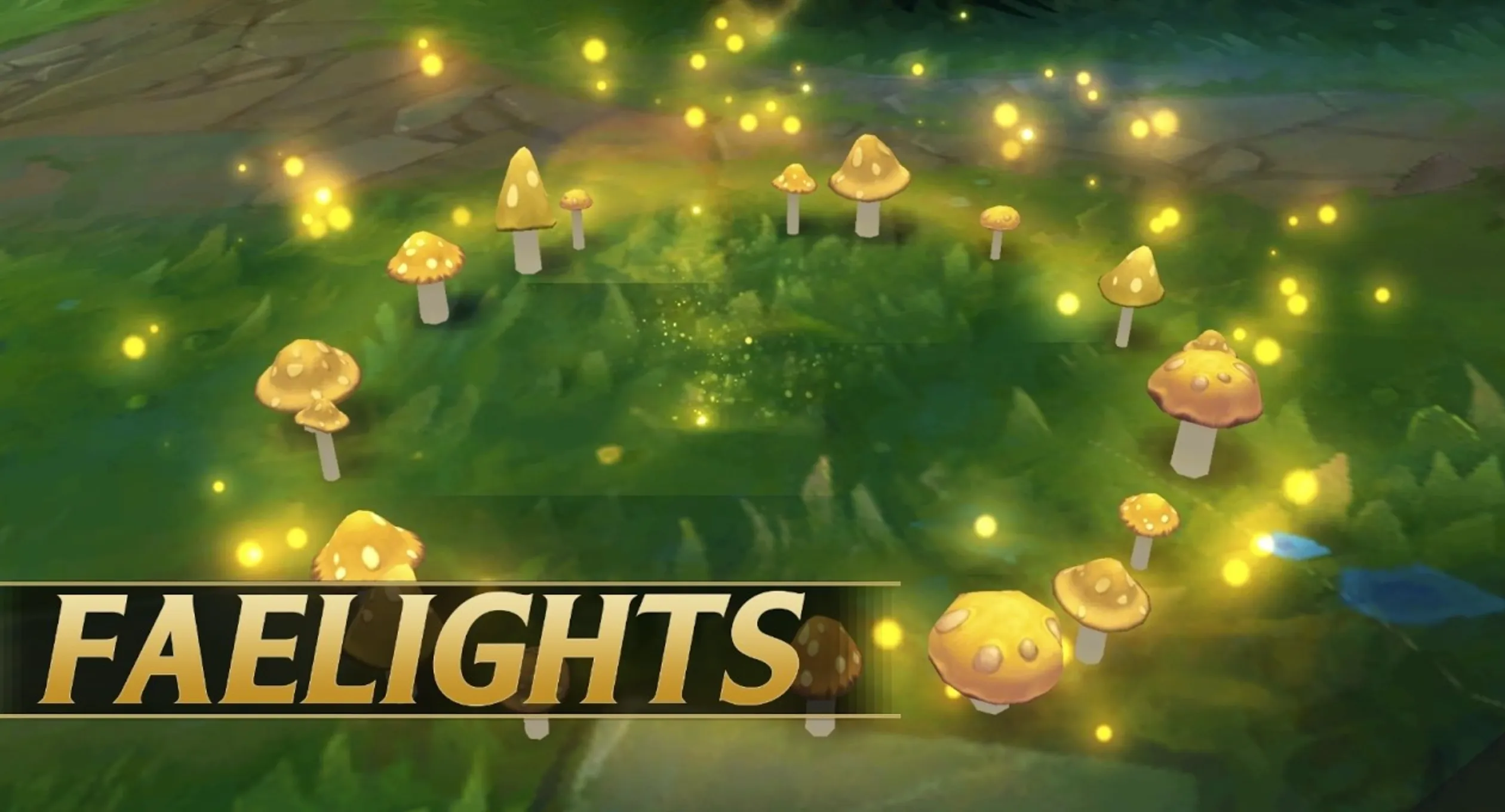
Visually, Faelights show up as glowing, magical orbs hovering slightly above the ground. When a player moves close and interacts with one, it immediately reveals a chunk of nearby terrain for a short time. After being used, the Faelight vanishes and only comes back after its cooldown, which means teams need to pay attention to when and where they’ll respawn. Because the vision is limited and temporary, timing matters just as much as positioning.
Faelights don’t give gold, stats, or permanent buffs. Their entire value comes from information. They’re especially useful for tracking jungle movement, checking objectives like Dragon or Baron, and setting up rotations during the mid and late game. Unlike normal wards, Faelights can’t be destroyed or denied once placed, and no team owns them by default. Whoever reaches and activates them first controls the vision, which naturally creates small fights and standoffs around key areas of the map.
Faelight Spawn Locations and Timings

Knowing where Faelights show up and when they become available makes a big difference in how you control vision and prepare for fights. Because these vision orbs appear in fixed spots, learning their locations lets you plan safer rotations, avoid risky face-checks, and contest key areas before objectives spawn.
At the very start of every match, eight Faelights are already active across Summoner’s Rift. Four of them appear near each team’s base gates, with one positioned close to every base exit. These are especially useful when you’re under pressure, as they give quick vision into nearby jungle entrances and help spot early invades or enemies moving through your side of the map. Another two Faelights spawn in the island brushes next to the top and bottom lanes. These spots cover common river paths and are great for catching jungle ganks during the laning phase without forcing players to step into dangerous fog of war. The final two early-game Faelights are found in the curved river wall brushes near mid lane, often called the banana brushes. They give strong river vision while keeping you close to lane, making them perfect for tracking jungle movement around mid without overcommitting.
Once the game reaches the Elemental Rift stage, more Faelights are added. When the map transforms, usually around the 14 to 15 minute mark depending on dragon timing, four extra Faelights become available in the side lane jungle paths. These spawn parallel to the top and bottom lanes, with one in each quadrant of the map. They’re designed to support split-pushing and side lane pressure, giving teams better information when playing away from mid. These Faelights don’t exist during early laning, so it’s important not to look for them too soon. Once the map changes, though, they become key vision points for controlling flanks, tracking rotations, and setting up late-game plays.
How to Find Faelights in League of Legends Fast
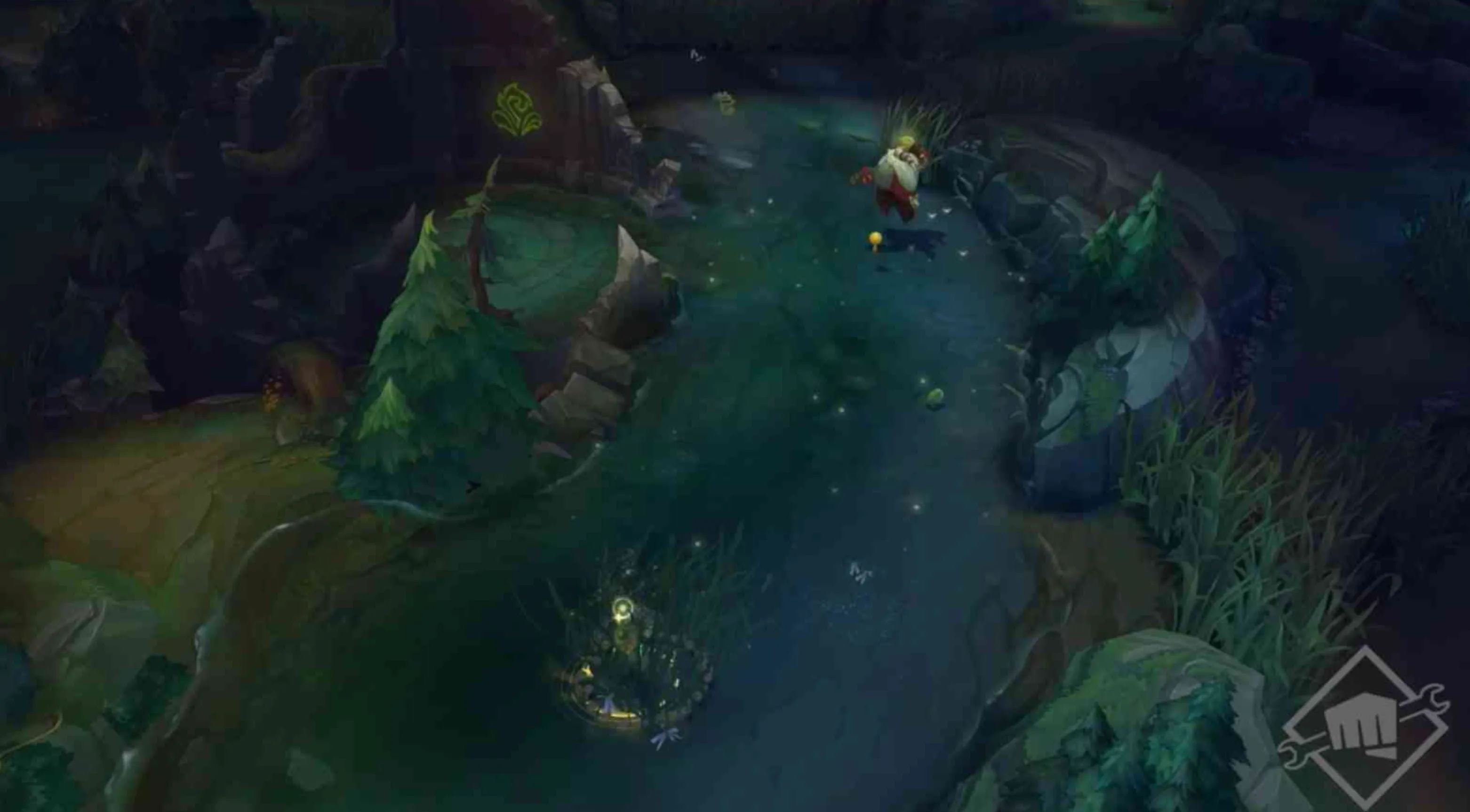
Spotting Faelights fast is pretty simple once you know what to look for. On your minimap, Faelights appear as small, glowing dot markers placed at fixed positions around Summoner’s Rift. If you move your cursor over one of these dots, the game previews the exact area of vision you’ll gain by activating it, which makes it easy to judge whether it’s worth contesting. Each Faelight covers a slightly different shape depending on its location, with some offering a wide circular view and others stretching down jungle paths or along river routes. None of them are copy-pasted, so learning their individual coverage helps you make smarter decisions during rotations. When the Elemental Rift transforms, you’ll also notice extra Scryer’s Bloom plants appearing around the map at the same time side lane Faelights unlock. These plants pair naturally with Faelights, giving you more ways to scout deep areas, protect split-pushers, and keep vision while defending or setting up plays later in the game.
How Faelight Superwards Work in LoL?
Dropping a ward directly onto a Faelight ring turns it into what players call a “superward,” and it behaves very differently from a normal ward placement. The moment the ward is placed, its vision range is noticeably larger than usual, giving it roughly a quarter more sight than a standard ward. At the same time, a much bigger vision field activates around it for a fixed 45-second window, clearly shown by a visible countdown circle so you always know when the bonus is about to end. This enhanced coverage works the same way no matter what kind of ward you use, whether it’s a trinket ward, a control ward, or even a zombie ward, since the Faelight effect overrides ward type differences. The expanded vision also reveals enemies hiding inside nearby brushes, as long as those bushes fall within the bonus zone. On top of the gameplay impact, Faelight superwards also boost your vision score, granting extra credit as if you had placed an additional ward, without being penalized by staleness rules. Once the 45 seconds are up, the ward doesn’t disappear; it simply drops back to its normal vision range and continues working like any regular ward until it expires or gets cleared.
Faelight Limitations and Disruptions
Faelights come with built-in restrictions that keep them from becoming overpowering and also give enemies clear ways to play around them. A single Faelight can only support one enhanced ward at a time. If a teammate drops a new ward onto a Faelight that already has one active, the previous ward is instantly removed and replaced. This means you can’t stack multiple superwards on the same spot, and poor coordination can easily lead to wasted wards if players aren’t paying attention. Communication matters a lot more around these locations than with normal vision tools.
Faelight bonuses are also vulnerable to vision-disrupting effects. When a ward on a Faelight is hit by nearsight or similar vision-blocking abilities, its enhanced effects shut off for the duration of that debuff. During this window, the ward behaves like a normal one with no bonus area. If enemies manage to destroy the ward while it’s affected by nearsight, all Faelight benefits are lost immediately. Abilities such as Graves’ Smoke Screen or Quinn’s Blinding Assault are especially effective here, since they can temporarily neutralize the extra vision and create a clean opportunity to clear the ward. This makes Faelights powerful, but far from uncounterable when opponents know how to deal with them.
Common Mistakes Players Make with Faelights
Even though Faelights are simple to interact with, a lot of players still use them in ways that waste their real value. One of the biggest issues is timing early wards poorly. Many players activate or ward island brush Faelights around 1:20–1:30, but in most games the enemy jungler won’t be anywhere near those paths until closer to the first Scuttle window at around 3:00. Using a Faelight too early just gives you two minutes of empty vision instead of actionable information. Waiting until shortly before Scuttle spawns gives you a much clearer read on jungle pathing and early river control.
Another common mistake is ignoring Faelights that appear later in the game. After the map transforms, four additional side lane Faelights unlock, yet many players keep focusing only on the original eight. These side lane Faelights are extremely strong for split-pushing and defending against collapses. Skipping them often leads to unnecessary deaths when pushing side lanes without proper vision. Players also misuse control wards by placing them on Faelights near the enemy base, even though control wards usually provide more value in Dragon or Baron areas where denying vision directly impacts objectives. Faelights are great for information, but they’re not always the best place to spend a control ward unless you’re actively sieging and need vision over walls.
Face-checking is another recurring problem. Instead of activating a nearby Faelight before moving into river or jungle corridors, players often walk straight into fog and get caught. Using the Faelight first gives you a 45-second safety window to scout rotations, ambushes, and setup plays without risking a pick. Finally, poor team coordination wastes a lot of vision. When two teammates ward the same Faelight within seconds, the first ward is instantly destroyed, burning two trinket charges for the same short vision duration. A quick ping or short communication before warding avoids this mistake, especially during mid-game rotations when everyone is scrambling to secure vision at once.
Tips for Using Faelighs in LoL
Using Faelights well is all about activating them at the right moment and tying their vision window to what your team is trying to do on the map. One of the smartest ways to use a Faelight is to trigger it just before your minion wave crashes into an enemy turret, since that’s when rotations, ganks, or collapses usually happen. Activating it too early often wastes the vision before anything meaningful occurs. With trinket cooldowns being relatively fast, it’s also better to hold a ward charge for a high-impact Faelight instead of dropping wards in low-value spots just because your trinket is ready. Faelights cover multiple angles at once, making them far more efficient than most standard ward placements. When enemies use Oracle Lens or control wards to deal with your Faelight vision, they’re committing limited detection tools to a predictable location, which opens the door to placing secondary wards deeper or in less obvious paths while they’re distracted. For split-pushing, warding a side lane Faelight before your top laner or ADC even shows up gives them instant safety once they start applying pressure, often covering an entire wave push within the 45-second window. Objective timing matters too: prioritize top-side Faelights when Baron is coming up and shift focus to bot-side Faelights when Dragon is the next fight. Aligning Faelight usage with upcoming objectives and lane pressure gives your team clear, timely information and makes it much harder for enemies to surprise you with flanks or last-second rotations.
FAQs
What patch added Faelights to League of Legends?
Faelights were introduced in Patch 26.1 as part of Riot’s ongoing changes to vision and map control on Summoner’s Rift.
Do Faelights replace wards in League of Legends?
No, Faelights don’t replace wards. They work alongside the existing vision system by offering fixed vision points that anyone can claim, while wards still provide flexible, player-placed vision.
Can both teams use the same Faelight?
Yes. Faelights are neutral until activated. Whichever team interacts with it first gets the vision, which is why they often become small contest points on the map.
Are Faelights permanent once activated?
No. Faelights only grant vision for a short time. After activation, they disappear and respawn later, so teams need to time their usage carefully around objectives and rotations.
Conclusion
Faelights add a new layer to vision control in League of Legends, rewarding players who think ahead instead of relying only on traditional warding. By understanding where Faelights spawn, when to activate them, and how to combine them with regular wards and objectives, you can gain critical information that wins fights before they even start. Used correctly, Faelights reduce risky face-checks, protect split-pushers, and give your team clearer reads on enemy rotations during the moments that matter most. As vision continues to decide games at every level of play, mastering Faelights is quickly becoming a key skill for climbing ranked and playing smarter on Summoner’s Rift.
Posted On: January 28th, 2026
Recent Articles


Our 1v9 support team is available 24/7 to help you with any questions or issues you may have.
support@1v9.gg

-a6d5b3e156bb.webp)





Loading...
1v9.gg is not endorsed or affiliated by any game developers or publishers.
2026 1v9, All Rights Reserved, Created By Ritesh (riteshsahoo.com)