

OSRS Crafting Training Guide
Crafting is one of the most useful and flexible skills in Old School RuneScape, and it’s available to both free-to-play and members from the very start. Through Crafting, you can make gear, jewelry, tools, and useful items that directly support combat, skilling, and questing. Many important upgrades in OSRS rely on Crafting levels, which makes it a core skill for long-term account progression rather than something optional or niche.
What makes Crafting especially valuable is how many ways there are to train it. You can gather raw materials yourself, buy supplies from the Grand Exchange, or combine Crafting with other skills like Mining, Smithing, and Magic. From early leather items to high-level jewelry and battlestaves, Crafting steadily improves both your efficiency and your account’s overall power. In this guide, we’ll break down the best ways to train Crafting in OSRS, explain which methods are worth using at each stage, and help you level the skill as smoothly and efficiently as possible.
Types of Crafting in OSRS
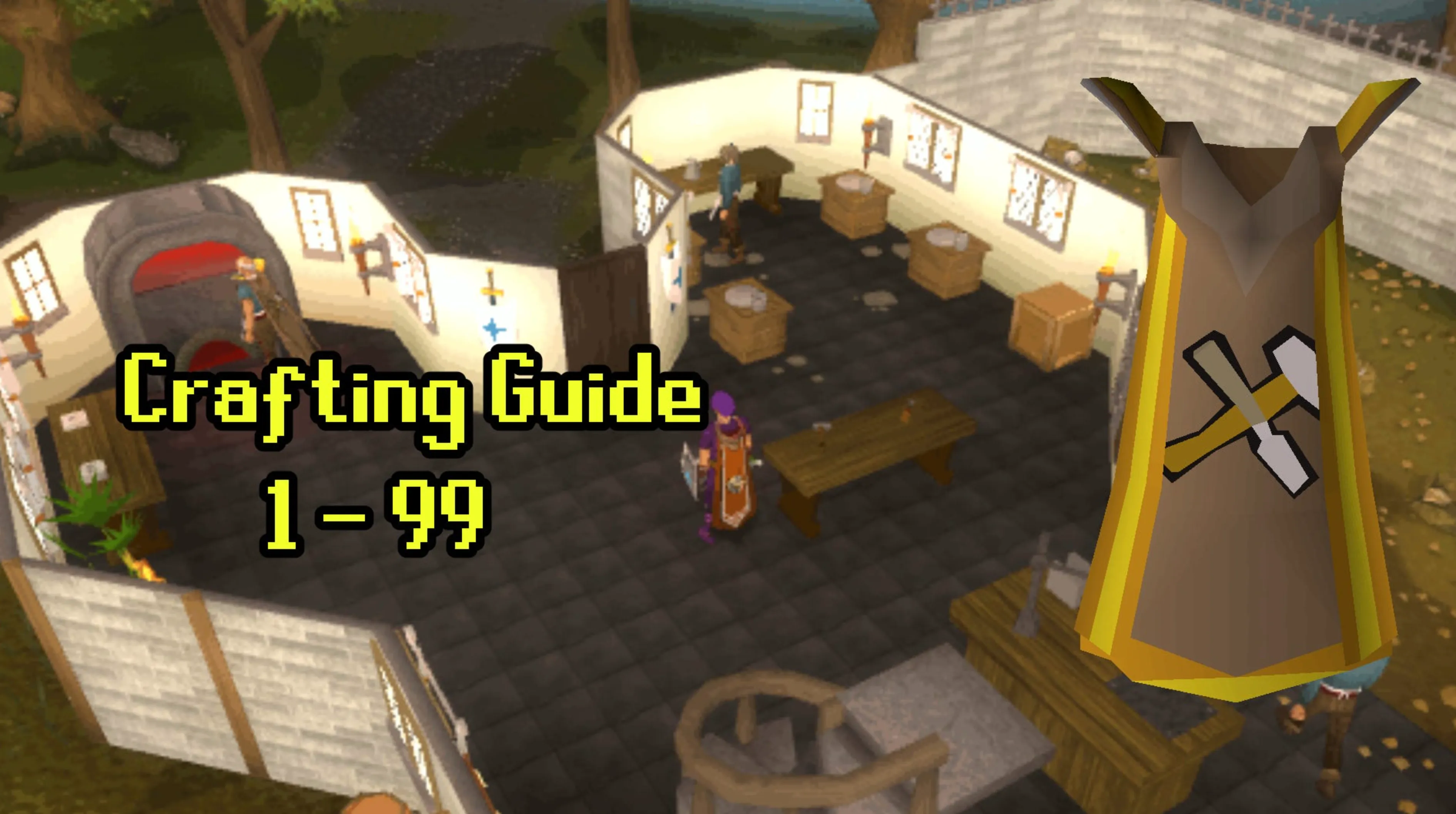
Crafting in Old School RuneScape is split into several different branches, each focusing on a specific type of item and training style, which is what makes the skill so flexible. Glass crafting revolves around turning sand and soda ash into molten glass, letting you produce useful items like vials, lantern lenses, and light orbs that are commonly used across other skills. Spinning uses a spinning wheel to turn flax into bowstrings and cloth-based items, making it a simple but effective way to train while supporting Fletching and early-game money making. Weaving focuses on materials like jute fibers and is mainly used to create nets and similar utility items, often tied to niche training or quests. Pottery involves shaping soft clay into items such as pots, bowls, and urns, then firing them in a kiln to finish the process, offering steady early Crafting experience. Armor and equipment crafting covers leather goods, dragonhide bodies, and other wearable gear that directly boosts combat effectiveness. Jewelry crafting is one of the most popular and profitable paths, allowing players to make rings, necklaces, and amulets that provide useful bonuses, enchantments, and strong Grand Exchange value, especially at higher levels.
How To Level UP 1-99 Crafting In OSRS
Reaching level 99 Crafting in Old School RuneScape is mostly about choosing the right methods for your account type and budget. Below is a clean, efficient 1–99 Crafting route that covers both Free-to-Play and Members, rewritten to focus on speed, clarity, and practical progression without wasting gold or time.
OSRS Free-to-Play Crafting Guide (1–99)
Levels 1–5: Leather Gloves
The fastest way to start Crafting in F2P is by working with soft leather. Simply use leather on a needle and thread to make leather gloves. This stage is extremely short and cheap, only requiring a few dozen gloves to hit level 5. It’s a basic intro that gets you moving quickly into jewelry.
Levels 5–20: Basic Gold Jewelry
From level 5 onward, gold jewelry becomes the core training method. Start with gold rings, then move into gold necklaces and gold amulets as they unlock. This stage is simple, consistent, and affordable, making it perfect for early Crafting without needing gem cutting or advanced tools.
Levels 20–40: Cutting Gems
Once you hit level 20, cutting gems becomes the best experience in F2P. Start with sapphires, then switch to emeralds as soon as you unlock them. This method is faster than jewelry and very straightforward, especially if you buy uncut gems directly from the Grand Exchange.
Levels 40–70: Higher-Tier Jewelry
From level 40, return to jewelry crafting but with better options. Ruby necklaces and diamond rings provide solid XP and are easy to mass-produce. This stage carries most F2P players through the mid-levels with minimal effort and stable costs.
Levels 70–99: Diamond Amulets
For the final stretch, diamond amulets are the standard F2P path to 99. While it’s a long grind, the method is simple, predictable, and doesn’t require switching techniques. Expect this to be the most expensive part of F2P Crafting, but also the most consistent.
OSRS Members (P2P) Crafting Guide (1–99)
Members have access to far faster and more flexible Crafting methods, allowing you to reach 99 much sooner if you’re willing to invest gold.
Levels 1–20: Early Leather Items
Just like F2P, leather gloves and boots are the fastest way to start. This phase is very short and mainly exists to unlock better methods as soon as possible.
Levels 20–62 / 77: Gem Cutting
Gem cutting is one of the strongest early-to-mid Crafting methods for members. Start with sapphires, then move through emeralds, rubies, diamonds, and dragonstones as you level up. XP rates increase sharply with each tier, and this method is fast, click-light, and easy to scale with your budget.
Many players cut gems until level 62 or 77, depending on whether they plan to switch early into battlestaves or dragonhide.
Levels 54–77 / 99: Battlestaves
Battlestaves offer a great balance between cost and experience. Starting at water battlestaves and progressing through earth, fire, and air battlestaves, this method is ideal for players who want strong XP without the extreme costs of high-end dragonhide crafting. It’s also a popular option for those aiming to save gold on the way to 99.
Levels 63 / 77–99: Dragonhide Bodies
For maximum XP rates, dragonhide bodies are the fastest Crafting method in the game. Start with green dragonhide bodies and move through blue, red, and black as your level increases. This method is extremely fast but also very expensive, making it best suited for players prioritizing speed over profit.
By the time you’re crafting black dragonhide bodies, Crafting becomes a straight sprint to level 99.
OSRS Crafting Training Tips
Training Crafting efficiently in Old School RuneScape comes down to preparation and smart decision-making. A few small habits can save you hours and millions of coins over the long run.
First, always prepare your materials ahead of time. Buying or gathering everything you need before you start lets you train in one smooth session without constant bank trips or price checks slowing you down. Long, uninterrupted crafting sessions are always faster and less frustrating.
Second, don’t ignore quests. Many early and mid-game quests give free Crafting experience that can skip entire level ranges. Doing these at the right time reduces how many items you need to craft manually and can save a lot of money, especially in the lower levels.
Finally, keep an eye on Grand Exchange prices. Crafting profits and losses change constantly, and a method that’s expensive today might be cheap or even profitable tomorrow. Checking prices before committing to a long grind helps you choose the best materials and avoid unnecessary losses while pushing toward higher levels.
Conclusion
Crafting is one of the most rewarding skills to train in Old School RuneScape, offering both strong utility and long-term value for your account. Whether you’re playing free-to-play or members, the skill gives you access to powerful gear, useful jewelry, and consistent ways to support other skills and quests. By choosing the right methods for your budget, keeping an eye on market prices, and taking advantage of quests and efficient training routes, leveling Crafting from 1 to 99 becomes a clear and manageable journey. With proper planning and smart upgrades along the way, Crafting turns from a costly grind into a smooth progression that pays off well into the late game.
Posted On: January 9th, 2026
Recent Articles


Our 1v9 support team is available 24/7 to help you with any questions or issues you may have.
support@1v9.gg


-a6d5b3e156bb.webp)





Loading...
1v9.gg is not endorsed or affiliated by any game developers or publishers.
2026 1v9, All Rights Reserved, Created By Ritesh (riteshsahoo.com)